

A broken-down car isn’t automatically exempt from towing charges just because it can’t be driven. In Victoria, operators set their own charges for voluntary breakdown towing, while accident towing and storage fees are regulated. To avoid paying towing fees for a broken-down vehicle in Melbourne, first find out whether a council or another authority has ordered its removal or whether you’re arranging a tow yourself.
Finding your vehicle marked for removal, damaged or unsafe to drive is stressful. Don’t risk driving it to avoid a tow. The right next step depends on why it’s being removed, where it’s being held and whether it can be collected safely.
This guide explains what to do if a vehicle faces a tow-away, what affects breakdown towing charges and how to respond when damage makes driving unsafe. It also covers when vehicle removal may be a practical alternative to leaving an unwanted or badly damaged car on the road.
Key Takeaways
- Read the parking signs and identify whether a council or another authority has ordered the vehicle’s removal before arranging anything.
- If damage makes the vehicle unsafe to drive, don’t risk moving it; the towing process can differ depending on whether the vehicle was involved in an accident or has broken down.
- Check your roadside assistance cover for towing conditions, distance limits and where the vehicle can be taken.
- Before approving a breakdown tow, understand what the quote includes and how distance, timing and storage could affect the final charge.
- If the vehicle is no longer worth repairing, vehicle removal may be a practical alternative to arranging a tow to a repairer.
Tow-away requests and vehicle removal
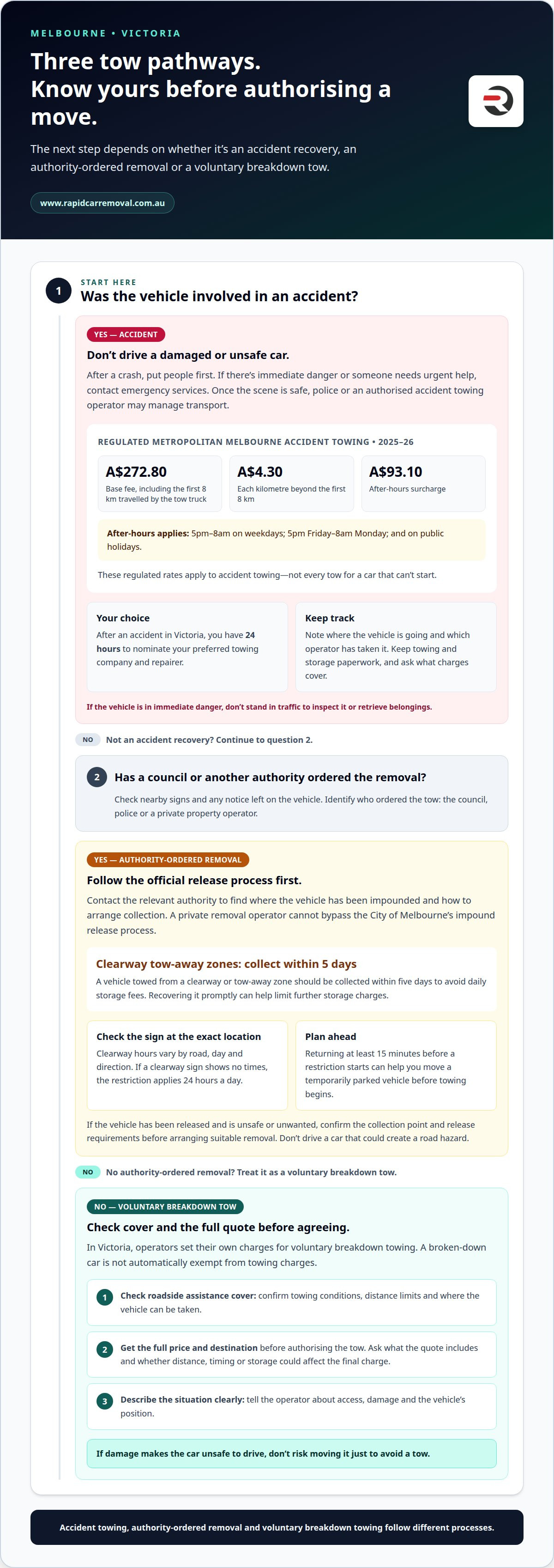
A vehicle marked for removal needs a different response from one awaiting a voluntary breakdown tow. First, identify who ordered the tow: the council, police or a private property operator. Check nearby signs and any notice left on the vehicle. The reason for removal affects where the tow truck takes it, how you arrange its release and whether storage charges may continue.
In Victoria, clearway rules are set out in the Road Safety Road Rules 2017, Part 12, Rule 176. A clearway sign gives the relevant hours and days; if it shows no times, the restriction applies 24 hours a day. Some clearways on major roads within 20 km of Melbourne’s CBD are tow-away zones. Read the sign at the exact street location, not only a sign further along the road.
Clearway hours vary by road, day and direction, so a familiar route can still have a different restriction nearby. A sign might apply during a weekday peak period, while another street has different hours. Check temporary parking signs as well as permanent ones, especially where roadworks or events have changed access. Returning at least 15 minutes before a restriction starts can help you move a temporarily parked vehicle before towing begins.
Melbourne tow-away zones include clearways on roads such as Punt Road, High Street and Dandenong Road. The City of Port Phillip may also tow vehicles parked in a clearway or blocking access. If a vehicle is removed, contact the relevant authority to find out where it has been impounded and how to arrange collection. A vehicle towed from a clearway or tow-away zone should be collected within five days to avoid daily storage fees.
What are your rights if a tow truck arrives without being requested or quotes a high fee in Victoria? Don’t assume an unsolicited operator has authority to tow your vehicle. Ask who requested the removal and why. For a voluntary breakdown tow, get the full price and destination before authorising the operator. If your vehicle is already being towed and the truck hasn’t left the area, you may be able to pay a release fee and have it set down at the nearest safe location.
A council-ordered tow is separate from a private breakdown tow. Follow the council’s official release process and ask for the collection details. If you believe the tow was improper, keep the notice, paperwork and photographs, and record what happened. Recovering the vehicle promptly can limit further storage charges. You can dispute an infringement separately.
How can a professional vehicle removal service help avoid storage fees and other extra charges after a car has been towed in Melbourne? Once the council releases the vehicle, arranging its removal may help prevent further storage charges while an unsafe or unwanted car remains in an impound yard. A private operator cannot bypass the City of Melbourne’s impound release process. If the car is still on the street and removal is voluntary, arranging collection before an authority orders a tow may avoid impound and storage costs altogether.
Before arranging removal, establish whether the vehicle is still impounded or has been released, and whether it can be driven safely. An unregistered, damaged or unsafe vehicle may not be allowed to leave an impound yard under its own power. Confirm the collection point and release requirements first, then arrange suitable removal instead of driving a car that could create a road hazard.
Towing vehicles that are damaged or unsafe to drive
Don’t drive a damaged car just to avoid a tow. A collision, failed steering or a wheel that no longer sits correctly can make even a short trip unsafe. In Victoria, accident towing is more regulated than general breakdown towing, particularly within Melbourne’s controlled area. First determine whether the vehicle was involved in an accident or has suffered a separate mechanical breakdown. That distinction affects the towing process and which charges may apply.
After a crash, focus on people first. If there’s immediate danger or someone needs urgent help, contact emergency services. Don’t stand in traffic to inspect a vehicle or retrieve belongings. Once the scene is safe, police or an authorised accident towing operator may manage the vehicle’s transport. Victoria’s Accident Towing Services Act 2007 governs accident recovery, operator licensing and fee regulations. Accident towing charges in metropolitan Melbourne are regulated, unlike ordinary breakdown towing charges.
For 2025-26, the regulated metropolitan Melbourne accident towing base fee is A$272.80, including the first 8 km travelled by the tow truck. Each kilometre beyond that costs A$4.30, and the after-hours surcharge is A$93.10. The surcharge applies from 5pm to 8am on weekdays, from 5pm Friday to 8am Monday, and on public holidays. These rates concern accident towing, not every tow for a car that cannot start.
After an accident in Victoria, drivers have 24 hours to nominate their preferred towing company and repairer. Keep track of where the vehicle is being transported and which operator has taken it. Ask for towing and storage paperwork, then check what the charges cover. If the vehicle is taken to an impound or storage yard, ask about collection arrangements and any costs that may continue while it remains there. An abandoned or uncollected vehicle can create a separate problem, so deal with its location promptly.
A breakdown unrelated to an accident follows a different process. Before authorising a private tow, establish the destination and full quoted charge, including distance and any applicable surcharge. A car that can’t be driven safely may need transport even if it’s parked in a car park or off the street. Give the operator clear details about access, damage and the vehicle’s position. Accurate information helps them plan the collection and avoid arriving to find the car blocked in or inaccessible.
How can a professional vehicle removal service help if your broken-down car is on a freeway or in a dangerous location in Melbourne? Put personal safety first and seek emergency or road-authority assistance if the car creates an immediate traffic hazard. A removal service can help arrange collection once the vehicle is in a safe, accessible position, but it doesn’t replace emergency response or traffic control.
For a vehicle that is badly damaged, unregistered or no longer worth repairing, removal may be more practical than towing it to a repairer. The vehicle’s condition, location and access determine how collection can be arranged. Share those details before confirming the service, and keep any accident or impound paperwork available. To discuss vehicle removal options, provide the vehicle’s location and explain whether it was involved in an accident or has broken down.
Does roadside assistance cover towing a broken-down vehicle in Melbourne?
Roadside assistance may include towing, but cover depends on your policy or membership terms. Some plans arrange a tow only when roadside repairs aren’t possible; others limit the distance, destination or breakdowns covered. To avoid paying towing fees for a broken-down vehicle in Melbourne, check your cover before arranging a separate tow. Read the policy details and confirm what assistance applies to your vehicle and location.
Start with the policy schedule and towing section. Check whether cover applies to a mechanical breakdown, flat battery, puncture or accident. Accident recovery and an ordinary breakdown tow can follow different rules in Victoria. For example, cover for a failed starter doesn’t automatically mean a vehicle damaged in a collision is covered.
Next, check how the tow must be arranged. Some cover requires you to contact the assistance service and wait for its authorised operator. If you arrange a private tow first, your policy might not reimburse the cost. Read the process before authorising a tow truck, and record any reference number or approval given during the call.
- Distance: Check whether the policy sets a towing distance limit or restricts the destination.
- Destination: Find out whether the car can go to your chosen repairer, home or another location.
- Vehicle eligibility: Confirm the covered vehicle, driver and breakdown type match your membership details.
- Extra charges: Read how the policy treats storage, after-hours attendance or transport beyond an included limit.
- Location: Explain whether the car is on a Melbourne street, in a car park or creating a traffic hazard.
Location matters because the usual breakdown process may not suit a car in an unsafe position. If a vehicle is blocking traffic or stopped on a freeway, prioritise immediate safety and follow emergency or road-authority instructions. Give the assistance service the exact location, direction of travel and access conditions. Don’t assume membership replaces the need for urgent traffic management.
Ask what happens if the vehicle can’t be repaired roadside. The service might arrange transport to a repairer, while your policy sets the permitted destination and any extra distance costs. A car that breaks down near home could be treated differently from one stranded elsewhere in Melbourne, depending on the cover terms. Before approving the work, ask for the destination and any chargeable part of the tow.
Keep a record of the breakdown, assistance call and tow. Note the time, location, vehicle issue, operator details and any approval provided. If you pay an amount yourself, request an itemised invoice. These details help you compare the invoice with the policy wording and explain any reimbursement request.
If you’re looking to avoid paying towing fees for a broken-down vehicle in Melbourne, consider whether repair is the right outcome. If your policy doesn’t cover the tow or the vehicle isn’t suitable for a repairer, another removal option may be more practical. Decide based on its condition, location and whether it can be transported safely. Before authorising separate collections, make sure you understand which service will move the vehicle and where it will go.
Before a vehicle is collected, confirm the cover, tow destination and any extra charges. If you need a separate tow, compare its scope with the assistance arranged under your policy. This can help prevent paying twice for transport or assuming roadside assistance covers a service it hasn’t approved.
A policy may cover a breakdown tow if its terms include the type of breakdown, towing arrangements, limits and destination. Check your policy before arranging a tow. The information in this section doesn’t establish whether a manufacturer warranty covers it.
Does Victorian law regulate towing fees for private vehicle breakdowns?
Victorian law distinguishes accident towing from a voluntary tow after a mechanical breakdown. Accident towing and storage charges are regulated in metropolitan Melbourne. Operators set their own charges for private breakdown towing and other unregulated towing services. A regulated accident-towing fee schedule therefore doesn’t automatically cap the price of collecting a car that has simply stopped working.
The type of incident matters. A car damaged in a collision may fall under accident-towing rules, while a car that won’t start in a driveway usually needs a breakdown tow. The vehicle’s condition alone doesn’t determine which category applies. Before agreeing to a tow, explain how it became undriveable, where it is now and whether another vehicle was involved.
The Essential Services Commission reviews metropolitan Melbourne accident-towing and storage fees every four years. This review covers regulated accident services, not the price an operator sets for a private breakdown tow. For a voluntary tow, understand the offer before authorising it. Ask for the total quoted amount and what it includes.
Get specific details rather than accepting a vague estimate. Confirm:
- Where the vehicle will be taken, such as a repairer, home or storage yard.
- Whether the quote covers the whole journey or changes with distance.
- Whether after-hours attendance, difficult access or vehicle condition affects the charge.
- Whether storage or handling costs could apply after delivery.
- Who is responsible for payment if someone else arranged the tow.
These details matter because an initial quote may not include every part of the job. For example, a car in an underground car park may need different access arrangements from one parked on an open street. A vehicle that cannot roll or steer may also require a different collection method. Make sure the operator knows these details before you confirm the booking.
Keep evidence of what you agreed to. Save texts, emails and call notes, along with the operator’s details. After the tow, request an itemised invoice showing the work and charges. Compare it with the original quote and note any differences. If a charge doesn’t match what you approved, raise the issue with the operator and keep copies of the response and supporting documents.
Australian Consumer Law, Schedule 2 of the Competition and Consumer Act 2010, protects consumers against unfair practices, misleading conduct and unconscionable behaviour. If you believe a towing charge involves unfair trading, Consumer Affairs Victoria can be contacted on 1300 558 181. Keep the quote, invoice and relevant messages together when explaining your concern.
A council-ordered tow differs from a private breakdown booking. If an authority has impounded the vehicle, follow its release process before arranging another operator. A private tow company cannot replace the council’s release requirements with its own collection process. Confirm the vehicle’s status and collection arrangements first, so you don’t organise transport that cannot yet proceed.
For an unwanted or damaged vehicle that needs removal rather than a repairer’s tow, discuss your vehicle removal options and provide its location, condition and access details.
Towing is legal in Melbourne, Victoria, but towing companies must follow applicable rules and hold the appropriate licences and permits. These are estimates, not a fixed price for every job, so Melbourne drivers should confirm the quoted price before authorising a breakdown tow.
The after-hours surcharge for regulated accident towing in metropolitan Melbourne applies from 5pm to 8am on weekdays, from 5pm Friday to 8am Monday, and on public holidays. That schedule concerns regulated accident towing, rather than setting a surcharge for every private breakdown tow. A separate local refund limitation may also matter: the City of Port Phillip does not accept statutory declarations or medical certificates for exceptional-circumstances tow-fee refunds. Check which type of tow and charge is involved, and keep the quote and invoice so you can compare the agreed amount with the final bill.
Rapid Car Removal
Rapid Car Removal can help when a broken-down, damaged or unwanted vehicle needs removal rather than a tow to a repairer. Its Free Car Removal service is suitable for cars that can’t be driven safely or are no longer worth repairing. For a truck that has reached the end of its road use, Rapid Car Removal also offers Scrap Truck Removal.
If a council has impounded the vehicle, complete the official release process before arranging private removal. For a vehicle at home or another accessible location, share its condition, position and access details to help plan collection. The right option depends on the vehicle and where it’s being held.
Contact Rapid Car Removal to discuss removing your vehicle.
Choose the next step for your vehicle
To avoid paying towing fees for a broken-down vehicle in Melbourne, focus on the outcome you need: repair, a safe move or removal. If the car is no longer suitable for repair, consider whether selling it or arranging removal is a better fit than paying to transport it to a workshop. The vehicle’s condition and location will help guide your decision.
Rapid Car Removal offers Cash for Cars, Free Car Removal and Scrap Truck Removal. These services suit unwanted vehicles that can’t be driven or are no longer worth keeping. Share the vehicle’s condition and location to arrange the next step.
Contact Rapid Car Removal to discuss your vehicle. A clear plan can help you move forward with confidence.
Frequently Asked Questions
What if the car was damaged or cannot be driven?
If damage makes your car unsafe, don’t drive it. Arrange suitable transport instead. For example, tell the operator if a wheel is damaged, the car is stuck in a car park or access is restricted. Give the exact location, condition and registration details when arranging collection. If the vehicle is at an accident scene or in an impound yard, establish who controls its release before arranging private removal.


