

A car that won’t start can still be sold, even after sitting unused for years. If you’re ready to sell your car to free up garage space, you don’t have to assume it must be repaired first. Its condition, ownership status and ability to be legally transferred all matter.
An unused car can take up valuable room, while repairs may not be worth the expense. Before deciding, consider what the car needs, its condition and the value you could receive without repairing it.
This guide explains which vehicle details and records to prepare, how to weigh repair costs against potential resale value, and what can affect an unused car’s value. You’ll also learn what to consider when selling a car that doesn’t run, so you can decide whether to repair it or clear the space without taking on unnecessary work.
Key Takeaways
- Gather the car’s make, model, year, approximate mileage and registration status to help a professional assess it.
- A car that has been sitting unused may still be sellable, even if it doesn’t run; its condition, ownership status and transfer requirements matter.
- Before arranging repairs, weigh the likely sale value after the work against the total repair cost.
- Look beyond visible damage: inactivity can affect the battery, tyres, fluids, brakes, wiring and other components.
- Clearing an unwanted car can return useful garage space and help you decide what to keep, sell, donate or discard.
Information and records a professional buyer needs to assess your car for sale
Roadworthy requirements vary by state or territory and vehicle status. In Queensland, sellers of most registered vehicles generally need to supply a current safety certificate, according to Queensland Government.
With a private sale, you advertise the car, respond to enquiries and manage the sale yourself. A professional buyer assesses the vehicle and handles the purchase process with you.
A professional buyer can record the registration details and explain the handover steps. Registration transfer requirements vary across Australia, so the process depends on where the vehicle is registered.
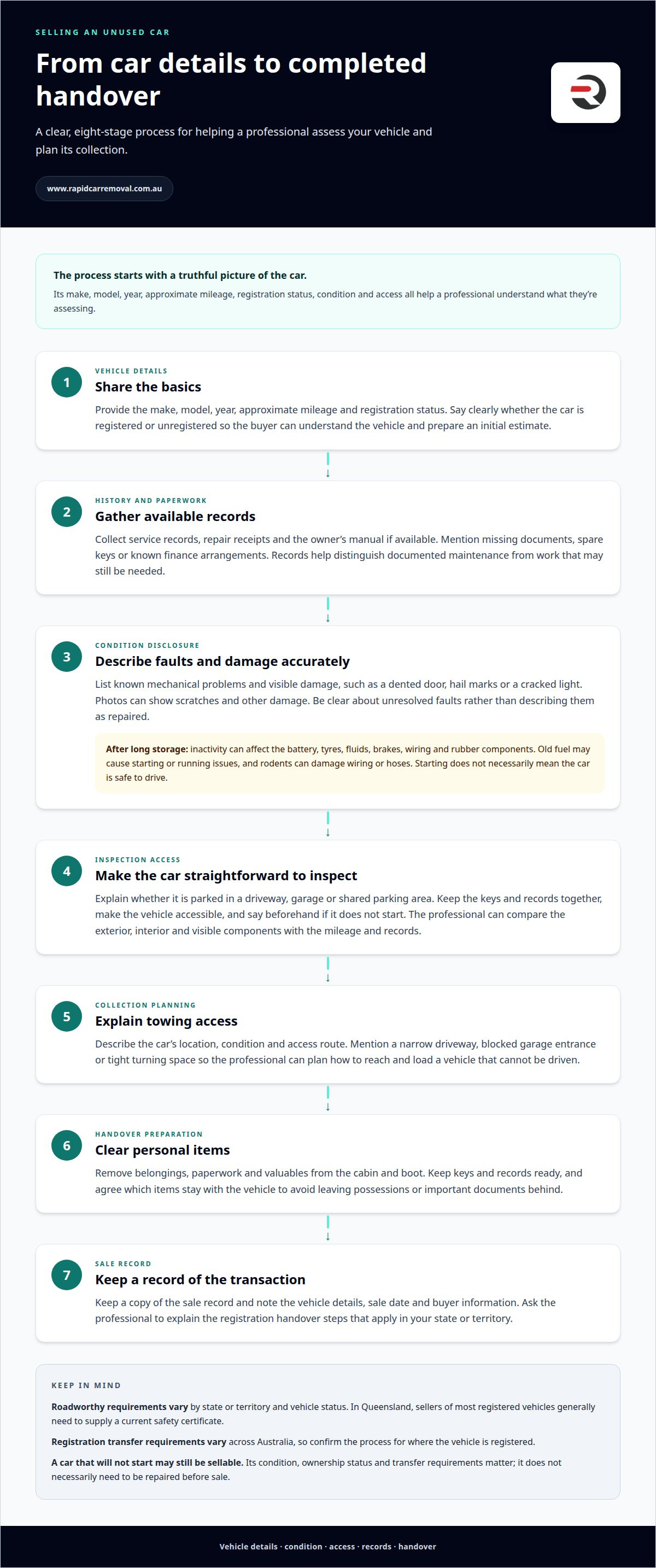
- Share the vehicle’s basic details. Give the make, model, year, approximate mileage and registration status. These details help the buyer understand what car they’re assessing and prepare an initial estimate. For example, state whether it’s registered or unregistered, rather than leaving that detail unclear.
- Gather records that help explain its history. Bring available service records, receipts for repairs and the owner’s manual. Mention missing documents, spare keys or known finance arrangements. These records can help the buyer distinguish documented maintenance from work that may still be needed.
- Describe the condition accurately. List known mechanical problems and visible damage, such as a dented door, hail marks or a cracked light. Photos can show scratches and other damage before an inspection. Clear details help the buyer compare the description with the vehicle’s actual condition.
- Make access straightforward for inspection. Tell the buyer where the car is parked, including whether it’s in a driveway, garage or shared parking area. Keep the keys and relevant records together. If the car doesn’t start, say so before the inspection, so the buyer can assess it appropriately.
- Allow a practical inspection. The professional can examine the exterior, interior and visible components, then compare those observations with the mileage and records. Keep the vehicle accessible and point out issues such as a damaged bumper or warning light. Don’t describe an unresolved fault as repaired.
- Explain towing access before collection. Describe the vehicle’s location, condition and access route. Mention a narrow driveway, blocked garage entrance or tight turning space. These details help the professional plan how to reach and load the car, especially if it cannot be driven.
- Prepare the vehicle for handover. Remove personal belongings, paperwork and valuables from the cabin and boot. Keep the keys and records ready, and agree which items stay with the vehicle. A clear handover avoids leaving important documents or possessions behind.
- Record the sale details. Keep a copy of the sale record and note the vehicle details, sale date and buyer information. Ask the professional to explain the registration handover steps that apply in your state or territory. That gives you a clear record of the transaction and what happens next.
Can You Sell a Car That Has Been Sitting Unused for Years?
Yes. A car may still be sold after years off the road, depending on its condition, ownership status and transfer requirements. Minor damage or hail marks don’t automatically rule out a sale, but describe them accurately. If I decide to sell my car to free up garage space, I can consider its present condition rather than assume repairs must come first.
-
How a professional car-buying service handles sale timing and collection
Choose a sale method that suits your priorities. A private sale may bring a higher price, but you manage advertising, calls, inspections, no-shows and offers. A dealer trade-in can be convenient when buying another car, though the price is often lower. A professional buyer offers another option; timing depends on the vehicle, paperwork and collection access, not a fixed schedule.
Share the car’s details and condition to receive an assessment before deciding to sell. If you’re thinking, “I want to sell my car to free up garage space,” Rapid Car Removal offers Cash for Cars and free removal across Melbourne, including for unwanted, damaged and non-running vehicles.
-
How to check for finance owing before selling your car to a professional buyer
Review any finance attached to the vehicle before agreeing to sell. An outstanding obligation can affect ownership transfer, so clarify the amount owing and the steps needed to settle it. Keep the sale and payment arrangements clear before completing the handover.
For a private sale, be cautious of overpayment offers and unusual payment methods. Don’t hand over keys or paperwork until payment has cleared in your account. For a test drive, meet in a public place or bring a friend.
- Disclose damage clearly. Tell the buyer about hail marks, dents, scratches and known faults. A professional assesses the vehicle against its description. Clear disclosure helps avoid a mismatch between the information provided and the car’s condition at inspection or collection.
- Describe the effects of storage. Inactivity can affect the battery, tyres, fluids, brakes, wiring and rubber components. Old fuel may also cause starting or running issues, while rodents can damage wiring or hoses. A car that starts after years unused isn’t necessarily safe to drive.
- Explain whether it runs and where it is parked. A car sold for removal doesn’t need to be cleaned, repaired or running before pickup. Describe its location and access, especially if it’s behind a narrow garage entrance or in a tight driveway.
- Handle ACT registration correctly. In the ACT, registration doesn’t need to be renewed, and the car doesn’t need to be deregistered before sale to a car removal service. The service can handle deregistration if needed.
- Separate household items from the car. Sort belongings into keep, sell, donate and discard groups. For example, move usable tools or furniture out before collection, and store vehicle paperwork separately from household items.
- Protect the handover. Confirm the agreed payment before handing over the vehicle and its paperwork. Keep a record of the transaction, including what was sold and the date, for your own files.
Comparing repair costs with potential sale value
Compare the likely sale value after repairs with the total repair costs before deciding what to do. A private sale may bring a higher price, while selling to a dealer or professional buyer can spare you advertising, enquiries and missed appointments.
- Get a clear diagnosis first. Ask a mechanic to identify the work needed before approving repairs. A car that has sat unused may need attention to its battery, tyres, fluids, brakes, wiring or fuel system. Separate safety-critical work from cosmetic fixes, such as repainting a scratched panel.
- Request itemised repair estimates. Ask for the parts and labour involved in each job. For example, a quote that lists brake repairs separately from a new battery makes it easier to see which work drives the total. Include any further repairs identified during inspection, not just the first fault.
- Estimate the car’s value in its current condition. Consider its make, model, year, mileage, registration status and known faults. Compare vehicles with similar features and condition, rather than relying on a higher-priced example that has a roadworthy inspection or recent repairs.
- Estimate its value after the proposed work. Ask what the car could reasonably sell for once those specific repairs are complete. A repair only supports the decision if it addresses a factor buyers care about. Replacing a faulty component may help; cosmetic work may not recover its cost.
- Compare the two totals. Subtract the repair expenditure from the likely post-repair sale value. Then consider the time and effort involved in organising repairs and selling privately. If the remaining difference is small, selling the vehicle as-is may be the more practical choice.
- Compare selling options on more than price. A private sale may offer a higher return, but you manage advertising, enquiries, inspections and negotiations. A dealer or professional buyer provides a different route, with the vehicle’s condition and sale arrangements shaping the assessment.
- Ask what affects an as-is assessment. A professional buyer considers the vehicle’s condition, usable components and potential for recycling. For example, damage to one panel differs from faults affecting the engine, gearbox or other major components. A quote depends on the vehicle and is provided after a quote request.
- Decide before authorising optional work. Write down the repair estimate, likely sale value after repairs and expected value as-is. If repairs cost more than the likely increase in sale value, avoid spending on work that won’t improve the outcome enough to justify it.
Factors affecting an unused car’s resale value
A professional buyer in Australia assesses a car by considering its identity, condition, registration status and potential use. The same model can attract different assessments when mileage, damage or mechanical condition differs.
- Provide accurate vehicle details. Share the make, model, year, approximate mileage and registration status. These details help identify which vehicle is being assessed and provide context for its condition. For example, a low odometer reading doesn’t show whether the car has been stored well or maintained.
- Explain how long it has been unused. Long inactivity can contribute to mechanical problems, deteriorating rubber components, corrosion and electrical faults. Share when it was last driven and any known symptoms, such as difficulty starting or warning lights. A clear timeline helps buyers interpret the car’s present condition.
- Describe the mechanical condition honestly. Report known faults, including engine trouble, electrical issues or brakes that need attention. Old fuel can degrade and cause starting or running problems. A car that starts after extended storage isn’t necessarily safe to drive, so don’t treat a brief start as proof of roadworthiness.
- Point out exterior and interior damage. Identify dents, hail marks, scratched paint, cracked lights, torn seats or missing trim. The size and location of damage can affect the assessment. For example, damage to a door differs from damage that affects how it opens or closes.
- Account for tyres and rubber parts. Tyres on a stationary car may lose pressure, develop flat spots or suffer age-related damage. Rubber hoses and seals can also deteriorate over time. Mention visible cracking, leaks or deflated tyres, rather than describing the car only by its paintwork.
- Gather useful maintenance records. Service entries and repair receipts can show what has been maintained and which faults remain unresolved. Note gaps in the records clearly. A receipt for a replaced component, for example, gives buyers context that a verbal claim alone cannot provide.
- Clarify what remains with the vehicle. Tell the buyer whether keys, accessories or components are missing. An absent spare key or removed part changes the vehicle’s completeness. List these details before an inspection, so the assessment reflects the car being sold.
- Compare condition, not just model names. A private listing for the same make and model may not match an unused car with different mileage, damage or mechanical issues. Compare like with like, then consider how registration status and repair needs affect buyer interest. Treat an asking price as a comparison point, not proof of the car’s value.
Before accepting an assessment, check that it reflects the vehicle’s actual condition and the details you supplied. A clear description of mileage, storage, faults and damage helps buyers assess its value.
Reasons to clear unwanted cars from garages
A garage can be crowded by a car, household belongings or both. Nearly half of people surveyed in Australia said their garage was too full to park their car. Before moving anything, decide what you need the space for and whether the unused vehicle still serves a purpose.
- Set a clear purpose for the space. Decide whether you want room for the car you drive daily, storage, or a work area. For example, parking the family car inside may matter more than keeping an unused vehicle near the garage entrance. A specific goal helps you judge which items are taking up space without earning it.
- Consider what keeping the car involves. An unused vehicle may need attention before it can be driven again. Its tyres, fluids, brakes and electrical parts can deteriorate during storage. If nobody plans to use it, the space it occupies may be more useful than the uncertain prospect of putting it back on the road.
- Factor in registration and future plans. Note whether the car is registered and whether someone genuinely intends to drive it. If plans keep being postponed, decide what would need to change for the vehicle to leave the garage. A car without a practical role can continue occupying valuable parking space.
- Choose another place if you’re keeping it. Relocating the vehicle can free the garage without selling it, provided you have a suitable alternative parking or storage spot. Decide what the newly available area will be used for, such as protecting your daily car or storing bikes together.
- Remove household clutter separately. Sort belongings into keep, sell, donate and discard groups. Unused furniture or old equipment might be the real obstacle, rather than the vehicle. If the car still matters to you, clearing those items could create the access and storage space you need.
- Plan a staged clear-out. Allow days rather than hours to sort a garage with mixed belongings. Work through one area at a time, then sweep the floor, wipe the walls and measure the cleared space. Measurements help show whether your intended setup will fit.
- Make the decision match your goal. If you want to sell my car to free up garage space, consider whether the vehicle is the main thing preventing you from using the area. If household clutter is the bigger issue, start there instead. A clear purpose can help you avoid removing a car you still need.
- Take the next step once the choice is clear. If you’ve decided the unused car should go, set aside its keys and paperwork and make a plan for the belongings around it. For example, an owner thinking, “I want to sell my car to free up garage space,” can focus on clearing access for collection and deciding how to use the space afterwards.
If the unwanted car is the main obstacle, discuss your vehicle and collection needs.
Rapid Car Removal: Free Car Removal
Rapid Car Removal can help clear an unwanted car from your garage through Cash for Cars and free vehicle removal in Melbourne. Consider selling when the car has been sitting unused, needs repairs you don’t want to arrange or is taking up space you need back.
For a car in Melbourne, the sell my car service offers a professional route to a sale. Scrap Truck Removal is available for unwanted trucks. Share the vehicle’s make, model, year, approximate mileage, registration status and known condition to support an assessment. Be clear about whether it runs and how it can be accessed for collection.
If you’re ready to discuss your unwanted vehicle, contact Rapid Car Removal.
Make space for what matters next
Once you’ve decided to sell your car to free up garage space, give the cleared area a purpose. Plan whether it will be used for parking, organised storage or a practical work area. A simple plan can help stop it filling up again with items that don’t belong there.
Rapid Car Removal offers Cash for Cars and Free Car Removal for unwanted vehicles, as well as Scrap Truck Removal. If your vehicle is taking up room and you’re ready to move ahead, the next step is to share its details and discuss the sale and collection process.
Contact Rapid Car Removal to discuss your unwanted vehicle and take the next step towards a clearer, more useful garage.
Frequently Asked Questions
Can I sell a car that doesn’t run?
Yes. Rapid Car Removal buys vehicles that are running or not, including damaged and non-running cars. You don’t need to get an old vehicle started before arranging its sale. Describe its condition accurately, including whether it can roll and where it’s parked. That helps plan collection and gives the buyer relevant information about the car before handover.
Can You Arrange Removal for a Car That No Longer Runs?
Yes. Free Car Removal includes professional towing for vehicles that no longer run. Tell Rapid Car Removal whether the car is in a garage, driveway or another location, and mention access issues such as a narrow entrance. A car boxed in behind stored items may need a different collection plan from one parked beside the kerb.
Do you buy cars with no registration?
Yes. Rapid Car Removal accepts unregistered vehicles, and no roadworthy is required for unregistered car removal. Registration status can affect the steps for transferring or disposing of a vehicle, so provide accurate details when discussing the sale. If the car is registered in another state or territory, mention that too, as processes differ across Australia.
Does an Unused Car Still Have Resale Value?
It can. Even if a car isn’t suitable for driving, usable components such as its engine, gearbox, alternator, headlights or doors may retain value, depending on their condition and compatibility. A professional assessment considers the vehicle as a whole, not only whether it starts. Missing parts, corrosion or damage can influence which components remain usable.
How fast can you remove my car?
Rapid Car Removal provides free same-day vehicle pickup across Melbourne. After you accept an offer, pickup is within 60 minutes. Share the vehicle’s location and access details so collection can be organised around where it’s parked. For instance, let the team know if a building’s garage has restricted access or the car is behind a locked gate.
Is car removal really free?
Yes. Rapid Car Removal’s vehicle removal and towing are free to the customer. This applies to unwanted, old, damaged and scrap vehicles. The vehicle’s condition can affect its assessment, but removal itself isn’t charged. Before handover, make sure you understand the agreed sale details and keep a record of the transaction for your own files.
What documents do I need to sell a car in Australia?
Have available service records, repair receipts, the owner’s manual and keys ready. The make, model, year, approximate mileage and registration status also help identify the car. Documentation requirements can vary with the sale and registration circumstances. Rapid Car Removal handles the seller’s paperwork, so mention if records are missing or finance arrangements affect the vehicle.


