

An unregistered or non-roadworthy van can still be collected in Melbourne. Free van removal in Melbourne is available for vans that cannot be driven, including unregistered vehicles that do not have a roadworthy certificate. Share the van’s condition and location so collection can be planned safely.
It’s understandable to want clear answers before you deal with a van that’s taking up space or can’t be moved safely. This guide explains whether unregistered and non-roadworthy vans qualify, where collection is available across Melbourne, and how towing and recycling work.
You’ll also find practical steps for preparing the van and handling ownership and registration separately from collection. With those details clear, you can decide whether removal suits your situation.
Key Takeaways
- An unregistered or non-roadworthy van isn’t automatically excluded; learn what can affect its eligibility for removal.
- Find out how collection location and vehicle access can shape towing arrangements, including in outer Melbourne.
- Understand the general steps involved in vehicle wrecking and recycling after collection.
- Get a practical overview of the details and paperwork to prepare before arranging a van removal.
- See how cash-for-vehicle and removal services can help when a van or another unwanted vehicle needs to go.
Do you offer free towing for vans in outer Melbourne?
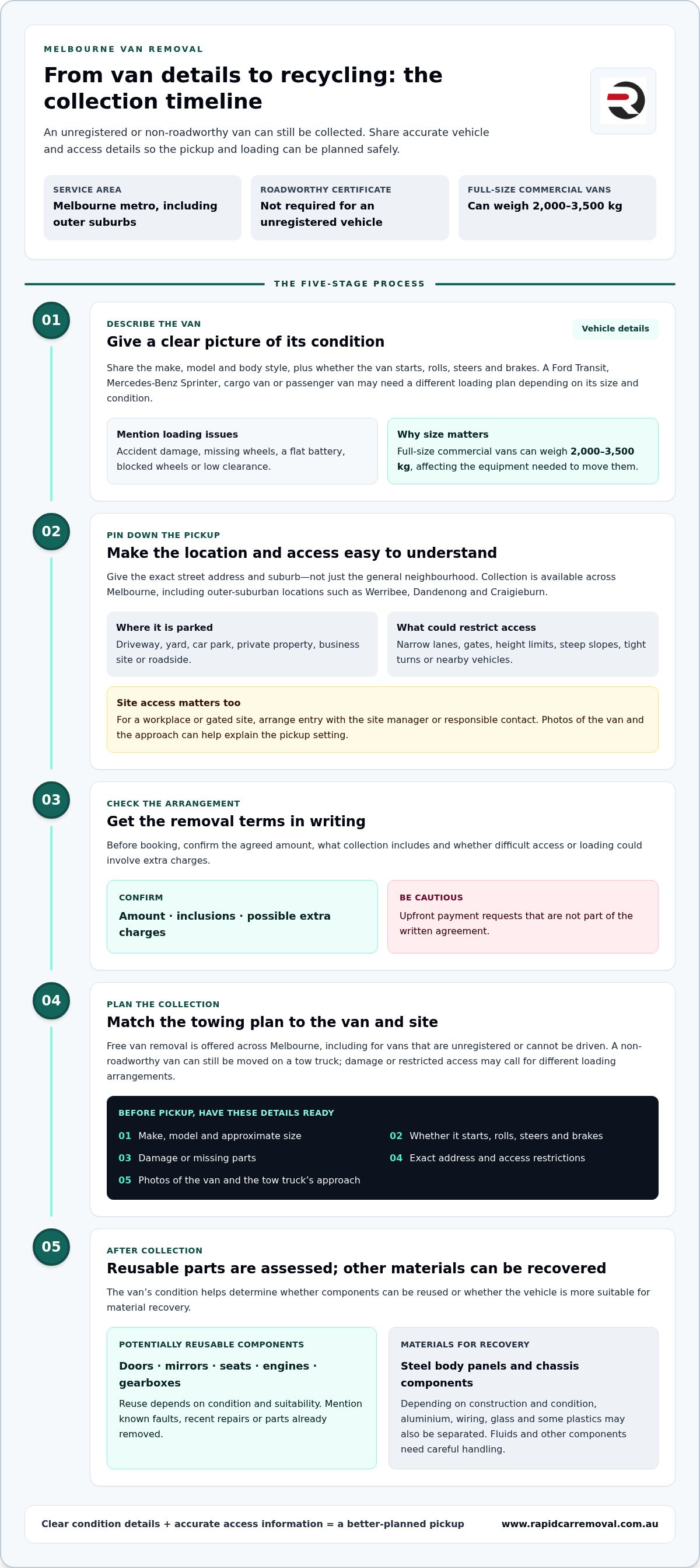
Rapid Car Removal offers free van removal across Melbourne, including for vans that are unregistered or cannot be driven. A roadworthy certificate is not required for an unregistered vehicle. Share the van’s condition, collection address and access details to help plan the pickup.
Vans come in different sizes and configurations. Examples include a Ford Transit or Mercedes-Benz Sprinter, as well as smaller cargo vans and passenger vans. Full-size commercial vans can weigh between 2,000 and 3,500 kilograms, so their size and loading affect the equipment needed to move them. Share the make, model and body style when arranging collection.
Condition matters for safe loading, not just whether the engine starts. A van with accident damage, missing wheels or a flat battery needs a different loading plan from one that rolls freely. Tell the removal team about damage, blocked wheels, low clearance and anything obstructing access. Clear details help them prepare a suitable tow vehicle and avoid delays at the pickup point.
Outer Melbourne collection also depends on where the van is parked. A clear driveway offers different access from a narrow laneway, basement car park or busy roadside. Mention steep slopes, height restrictions, gates and nearby parked vehicles. If the van is on private property, make sure the tow truck can reach it without moving other vehicles or belongings.
To reduce the risk of scams or unexpected fees, get the towing and removal terms in writing before booking. Confirm the agreed amount, what collection includes and whether any extra charges apply to difficult access or loading. Be cautious about requests for upfront payment that aren’t part of the written agreement.
Before arranging free van removal in Melbourne, prepare these details:
- Make, model and approximate size, such as a Transit or Sprinter.
- Whether it starts, rolls, steers and brakes.
- Damage or missing parts that could affect loading.
- The exact pickup address and any access restrictions.
- Photos showing the van and the approach for the tow truck.
These details help establish the right collection plan. A non-roadworthy van can still be moved on a tow truck, while a damaged or inaccessible vehicle may need different loading arrangements. Give an accurate description from the outset, especially if the van is parked behind another vehicle or inside a restricted car park. That makes it easier to plan towing and understand the removal terms before collection.
Melbourne collection locations and service availability
Van collection is available across the Melbourne metropolitan area, including outer-suburban locations. The pickup suburb matters because distance, road access and the van’s position affect how a tow truck can reach it. A collection in Werribee, Dandenong or Craigieburn still needs a clear address and practical access details. Share the suburb and street location when arranging the pickup.
Outer Melbourne covers varied settings, from residential streets in Pakenham to industrial areas around Campbellfield. A van parked at a workplace may need access arranged with a site manager. At home, a narrow driveway or shared parking area can affect where a tow truck can stop. Explain the setting, rather than giving only a suburb, so collection arrangements suit the actual site.
Access and distance are separate considerations. An underground car park may have a height limit, while a steep driveway can affect the approach for loading. Mention locked gates, tight turns, low branches and vehicles blocking the route to help the team plan the collection.
Vehicle movers usually need the van’s exact location, not just the general neighbourhood. Provide a street address and say whether the vehicle is on private property, in a public parking area or at a business. If it’s inside a gated site, explain how entry works. For a van left on a roadside, describe nearby landmarks such as a corner, entrance or service lane.
- Suburb and address: identify places such as Berwick, Melton or Frankston.
- Parking position: state whether the van is in a driveway, yard or car park.
- Access limits: describe gates, height restrictions, slopes or narrow lanes.
- Vehicle condition: note damage or parts that could affect loading.
- Site contact: arrange access with a property manager where needed.
For a business vehicle, coordinate collection with the person responsible for site access. A warehouse in Keysborough may have delivery traffic, while a residential pickup in Richmond may have limited kerb space. Give the best entrance and explain any site rules to help the team reach the right place and load safely.
Before booking, send the location details and clear photos of the van and its surroundings. Include the approach road, driveway or car park entrance. If you’re organising a collection in Melbourne, use the contact page to share the pickup information and discuss access arrangements.
Car wrecking and recycling
After collection, a van’s condition determines what can be reused or recycled. A van with usable components may be dismantled for parts, while a collision-damaged vehicle may be more suitable for material recovery. As car wreckers, Rapid Car Removal dismantles end-of-life vehicles and recycles parts.
Reusable components may include doors, mirrors, seats, engines and gearboxes. Their condition and suitability determine whether they can be set aside for reuse. Mention known faults, recent repairs or parts already removed when describing the van.
When components cannot be reused, the van can be separated into materials for recovery. Steel body panels and chassis components can go to metal recycling. Depending on the van’s construction and condition, aluminium, wiring, glass and some plastics may also be separated.
Fluids and other components need careful handling during dismantling. A vehicle may contain engine oil, coolant, fuel, brake fluid and a battery. These items are removed and managed separately from scrap metal. This prevents them from contaminating other materials and keeps the dismantling process organised.
- Inspect: assess the van’s condition and identify reusable components.
- Separate: remove parts that can be reused or sold separately.
- Drain: handle vehicle fluids and the battery apart from metal.
- Sort: group steel, aluminium, wiring, glass and other materials.
- Recover: send suitable materials into recycling streams.
A van’s age alone does not determine what can be recovered. A late-model vehicle with extensive collision damage may have fewer reusable parts than an older van with an intact engine or doors. Missing components, fire damage or severe rust can also affect what remains useful. A clear description helps set expectations.
Before collection, remove personal belongings and work equipment. Check the cabin, glovebox and cargo area for tools, paperwork, toll tags and business stock. Take out shelving or signage you plan to reuse, and tell the collection team about any loose parts left inside.
Recycling doesn’t mean every component becomes a new vehicle part. Some items may be reused, while others are processed as materials. The route depends on the component’s condition and composition. For owners, understanding that distinction helps set realistic expectations about what happens after a van leaves the driveway.
Free car and van removal in Melbourne
Arranging van removal involves more than choosing a pickup time. Provide accurate vehicle details, review the quote and keep ownership handover and registration cancellation as separate steps.
Arranging a removal booking
Start with the vehicle’s make, model, year if known, condition and pickup address. For example, identify whether it’s a Ford Transit van, a damaged car or a vehicle that won’t start. Explain access limits, such as a locked gate or a tight driveway, so the collection plan fits the site.
Share clear photos and describe missing parts or damage before accepting a quote. Read the terms for collection, towing and any payment carefully. Make sure the agreed amount and any conditions are recorded in writing, rather than relying on a verbal estimate that may not reflect the vehicle’s actual condition.
Ownership transfer and registration cancellation
In Victoria, ownership handover and registration cancellation are separate steps. Keep a record of the handover and follow the relevant Victorian process for registration cancellation. Towing alone does not complete either step.
Before collection, gather vehicle details and any paperwork showing your connection to the van. If someone else owns it, arrange their authority for the handover. Keep copies of signed documents and the collection record for your files.
“Free removal” describes the collection arrangement, but it doesn’t automatically explain every part of a transaction. If a quote includes payment for the vehicle, distinguish that amount from the towing terms. Ask for the agreed conditions in writing, including what happens if the van’s condition differs from the details provided.
Condition can affect an assessment. A van with intact components differs from one with collision damage or missing wheels. Explain whether the engine starts, whether the vehicle rolls and whether major parts remain in place. Accurate details help the team plan collection.
Use this preparation list before confirming a booking:
- Write down the make, model and vehicle location.
- Describe faults, damage and missing components.
- Photograph the van and the route to its parking space.
- Remove personal belongings, tools and business equipment.
- Keep the written quote and handover paperwork together.
For a car or van that can’t be driven, towing can move it without requiring a road trip. Check that the collection address, access details and vehicle condition match the booking information. Once the vehicle is collected, keep the handover record and finish any registration tasks separately. That gives you a clear record of what happened and which steps remain.
How do I arrange free van removal in Melbourne, and what documents are needed?
Plan the booking around the van’s condition, location and ownership details. Keep collection paperwork separate from registration steps so removal does not leave loose ends.
Share the van’s make, model, condition and exact pickup address. Explain whether it starts, rolls and steers, and describe any damage or missing parts. Include access details such as a narrow driveway, locked gate or low car-park clearance. Clear information helps the team plan towing and provide a relevant quote.
Review the quote and collection details before accepting. Check that they accurately describe the van and pickup location, and confirm the agreed amount. Request a quote online or by phone, and provide accurate details about condition, completeness, location and access.
Prepare useful records before collection. These can include proof linking you to the van, its registration details if available, the keys and a record of the agreed handover. Have photo identification ready if needed for the transaction. These are practical preparations, not a claim that every item is legally required for every removal.
If the van belongs to someone else, organise their permission before booking. For a company vehicle, get approval from the person responsible for the fleet. If an estate or another party controls the vehicle, make sure the person arranging collection has authority to do so. This helps prevent disputes about who can hand over the van.
At pickup, check that the vehicle being collected matches the booking. Remove personal items, tools, toll tags and work documents from the cabin and cargo area. Keep a copy of any signed handover record, and note the collection date and vehicle details for your files.
Collection and registration are separate matters. Towing the van does not automatically cancel its registration or complete an ownership change. Keep the registration information and handover record, then follow the relevant Victorian process for the van. Resolve any differences in ownership details before handover.
Use this simple preparation list:
- Record the van’s make, model, condition and pickup address.
- Describe access restrictions and provide clear vehicle photos.
- Keep the written quote and agreed collection terms.
- Gather available ownership and registration records, plus keys.
- Remove belongings and retain a handover record after collection.
Ready to organise collection? Send your van’s details and pickup location to get the booking process underway.
Rapid Car Removal: Cash for Cars
Rapid Car Removal can help when an unwanted vehicle needs a practical next step. Its Cash for Cars and Free Car Removal services suit owners looking to remove an unwanted car, while Scrap Truck Removal and Cash for 4x4s cover other vehicle types.
If your van is unregistered, damaged or no longer roadworthy, share its condition and collection location when discussing removal. Clear details help establish whether towing and vehicle handover fit your situation. Keep ownership paperwork and registration tasks separate from the collection itself.
For a car, truck or 4x4 that’s taking up space, consider the relevant removal service and prepare the vehicle details before getting in touch. Contact Rapid Car Removal to discuss your vehicle and collection needs.
Make space for what comes next
Choosing free van removal in Melbourne can be the start of a cleaner, more useful space. Decide what needs to happen after collection, whether that means clearing a driveway, freeing a work area or making room for another vehicle. A simple plan for the space helps turn removal into a practical next step, not just another task to manage.
Rapid Car Removal offers Cash for Cars, Free Car Removal and Scrap Truck Removal. The company also buys vans and provides free removal across Melbourne. Share the vehicle details and pickup address to request a quote.
There’s no need to have every detail worked out before taking the next step. Start a conversation, explain what vehicle you have and what you’re hoping to arrange. Contact Rapid Car Removal today to discuss your vehicle and move towards a clear plan.
With the right plan in place, you can get on with what matters next.
Frequently Asked Questions
Do you buy vans that are unregistered or non-roadworthy?
Yes. Rapid Car Removal buys unregistered and non-roadworthy vans, and no roadworthy certificate is required for an unregistered vehicle. Before handover, note whether the van has keys, number plates or removable business equipment. Describe its actual condition, including warning lights or previous repairs, when requesting a quote.
How much cash can I get for my van?
Make, model, condition, completeness and reusable parts can affect the offer. A van with intact doors and a working engine differs from one missing major components. Provide accurate details so the offer reflects the van you are selling.
Are there free van removal services in Melbourne, Australia?
Yes, free van removal in Melbourne is available through Rapid Car Removal, which offers free professional towing and removal for unwanted vehicles. The service covers vans, including vehicles that are damaged or unregistered. It can suit owners clearing a driveway, business parking area or workshop space. Describe the vehicle and collection setup so the removal can be planned around the van’s location.
What conditions must a van meet for free removal or donation in Melbourne?
For removal through Rapid Car Removal, a van can be running or non-running, damaged, written off or unregistered. The stated vehicle condition is that it must have wheels, or have had wheels. Donation is a separate arrangement with its own eligibility rules, so don’t assume a donation programme follows the same conditions. For removal, give an honest description of the van and its major parts.
Do Melbourne scrap yards offer free van collection, and how much do they pay?
Rapid Car Removal provides free towing and removal and offers cash for unwanted vehicles, including vans. Request a quote and share the van’s condition and pickup details to understand the offer and arrange collection.
Which Melbourne suburbs and areas are covered by free van pickup services?
Rapid Car Removal provides free vehicle removal across many Melbourne suburbs, including residential properties, workshops, business premises and other parking locations. Give the suburb and full address, then explain any access requirements. For example, a gated commercial yard may need an access contact, while a shared driveway may need a clear loading area.
Can an unregistered, non-running, or damaged van be removed for free in Melbourne?
Yes. Rapid Car Removal accepts unregistered, non-running and damaged vans, and provides free towing and removal. A van does not need to start or be roadworthy to be considered. Mention collision damage, missing parts or wheels that will not turn so the team can plan loading and prepare for the pickup.


