

What if disposing of a car that won’t start is more about arranging collection and sorting the paperwork than finding a buyer? If you’re searching for how to dispose of a car that doesn't run, you don’t need to get it back on the road or arrange a tow before exploring your options. The right route depends on the car’s condition, whether you want to sell it or have it removed, and what needs doing with its registration and plates.
A non-running car can’t be driven to a buyer or disposal site, and unclear towing costs or Victorian paperwork can add hassle. This guide compares practical options, explains the key VicRoads steps to check and covers what to prepare before collection.
Professional car removal can simplify the logistics in metropolitan Melbourne. Rapid Car Removal provides instant quotes, free professional towing and assistance with paperwork for unwanted vehicles in any condition. Use the checks below to choose an option and prepare for handover.
Key Takeaways
- Assess whether the car starts, rolls and can be accessed safely before choosing a disposal route.
- Compare a private sale, arranging transport yourself and professional removal to weigh up the effort involved.
- For how to dispose of a car that doesn't run, gather the vehicle details and check the Victorian steps for registration, plates and disposal paperwork.
- Clear out personal belongings and have the keys and ownership details ready for handover.
- A car that won’t start may need a different collection plan from one that can’t roll or is difficult to access.
A car that won’t run: what disposal options make sense in Melbourne?
A car that won’t start can’t be driven to a private buyer, a wrecking yard or another disposal site. Transport is part of the decision, not an afterthought. The right option depends on the car’s condition, where it’s parked and how easily it can be accessed.
When considering how to dispose of a car that doesn't run, compare the work involved as well as the sale process. A private sale may suit a vehicle with parts or repair potential, but you’ll need to coordinate with buyers and explain how they can inspect and move it. A removal service can bring collection and disposal together. Rapid Car Removal provides free professional towing across metropolitan Melbourne and instant quotes for unwanted vehicles in any condition.
Which disposal route suits a car that cannot be driven?
Start with what the car can physically do. A vehicle that won’t start but can roll may be easier to load than one with locked wheels, steering damage or limited access. A car in a narrow driveway, basement or busy street may also need a different collection plan from one parked in an open, accessible space.
- Private sale: You handle buyer enquiries and arrange a way for the car to be inspected and transported.
- Transport arranged independently: You organise a tow or other suitable transport, then manage the sale or drop-off separately.
- Professional removal: Collection and disposal are arranged together, reducing separate transport and buyer-coordination steps.
Scrap or salvage may suit a vehicle that is damaged or no longer practical to repair. The destination and handling depend on the vehicle and the arrangement. For background on what can happen to end-of-life vehicles, see this overview of the vehicle recycling process. Rapid Car Removal also offers cash for unwanted cars in Melbourne, with collection included as part of its removal service.
Why Melbourne and Victoria need their own paperwork guidance
Registration and number-plate steps depend on where the vehicle is registered. Advice about a NSW Notice of Disposal applies to NSW processes, not automatically to a Victorian vehicle. South Australia has its own procedures too. For a Melbourne vehicle, use VicRoads for current Victorian instructions rather than relying on another state’s forms or terminology.
Before disposal, check what applies to cancelling registration and dealing with the number plates. The steps can depend on your circumstances, including whether you intend to keep custom plates. Confirm the current requirements with VicRoads before handing over the car. Your plan should account for both the physical move and the Victorian paperwork.
Before disposal, check the car, access and Victorian paperwork
A few practical checks can make collection easier and help avoid surprises. Prepare the vehicle details and access information, then check the formal steps that apply to its registration. Having useful details on hand makes it easier to describe the car and plan its removal.
What to prepare before arranging a non-running car collection
Use this checklist to get the vehicle ready and give an accurate picture of its condition and location:
- Clear personal belongings: Check the glovebox, centre console, door pockets, boot and under the seats. Remove anything you want to keep.
- Gather available details: Note the make, model, year, registration status and any identifying details you have. Keep ownership or purchase records handy if available, without assuming a particular document is required in every case.
- Describe the condition: Mention accident damage, missing wheels or parts, flat tyres, locked steering and whether the engine starts. Be clear about whether the car can roll.
- Check the access route: Note narrow driveways, steep slopes, low-clearance areas, gates or other parked vehicles that could block movement.
- Find the keys: Set aside any available keys and explain if they’re missing or don’t operate the locks.
These are practical preparation steps, not a statement of legal requirements. Accurate information helps the collection team understand whether the car can be moved easily or needs a different loading plan. For example, a car that starts but can’t roll presents a different access issue from one that can roll but is parked behind a locked gate.
What to verify about registration and number plates in Victoria
For a Victorian-registered vehicle, check the latest disposal instructions directly with VicRoads. Registration cancellation and number-plate arrangements depend on your circumstances. Current VicRoads guidance says the registered operator can cancel registration online through myVicRoads if they aren’t keeping the plates. If you want to keep custom plates, VicRoads directs you to call or visit a Customer Service Centre.
After a sale or disposal, the seller must lodge a Notice of Disposal with VicRoads within 14 days. Use the Victorian process for a Victorian vehicle. NSW and South Australian forms, time limits and procedures aren’t substitutes for VicRoads instructions.
If the vehicle is unregistered, don’t assume the same registration steps apply. Check VicRoads guidance for your situation and have the status ready when arranging removal. Rapid Car Removal also handles cash for unregistered cars in Melbourne.
If an insurer has written the car off, treat that status as a separate detail and follow the relevant Victorian guidance. Once you’ve gathered the vehicle information and checked the paperwork, you can discuss vehicle collection with Rapid Car Removal.
Compare disposal options when your car cannot start or move
A car that won’t start still has disposal options. The practical choice depends on whether you want to manage a sale, organise transport yourself or have collection included in the process. Age, damage, missing parts, location and whether the car can roll all affect what’s workable. Compare the effort involved before committing to a route.
| Option | Effort and coordination | Transport planning | May suit |
|---|---|---|---|
| Private sale | You handle enquiries, buyer access and arrangements for inspection or handover. | Buyer collection or separate transport needs to be discussed and organised. | A car that may interest a buyer and can be made accessible for inspection. |
| Arrange transport independently | You coordinate a sale or drop-off and the vehicle’s move as separate tasks. | You organise transport to suit the car’s condition and destination. | Owners who have a preferred destination and are comfortable managing the logistics. |
| Professional vehicle removal | Collection and removal are arranged as part of one process, reducing separate coordination. | Professional towing is included with Rapid Car Removal’s service across metropolitan Melbourne. | Owners who want collection included, particularly when the car can’t be driven. |
Private sale versus a removal service for an immobile car
A private sale can involve extra back-and-forth because a buyer needs to understand the car’s condition and how they can view or move it. Be clear in the listing if it won’t start, can’t roll or has access restrictions. With a removal service, collection is part of the disposal arrangement, so you don’t have to coordinate a buyer and transport as separate steps. The better fit depends on your priorities and the vehicle.
When comparing how to dispose of a car that doesn't run, weigh the time and coordination against what matters most to you. Rapid Car Removal provides instant quotes for unwanted cars in any condition, with free professional towing across metropolitan Melbourne and assistance with paperwork.
When damage, write-off status or missing parts changes the decision
A mechanical fault, such as an engine that won’t start, is different from accident damage or an insurance write-off. Missing wheels, damaged steering or other missing parts can also affect how the vehicle is loaded and moved. Share these details early so the collection plan reflects the car’s actual condition.
For a damaged vehicle, a cash offer for damaged cars in Melbourne may be relevant. The vehicle’s details and condition affect any assessment, so don’t rely on a generic scrap-value estimate. For an option that includes collection, you can get in touch about your car.
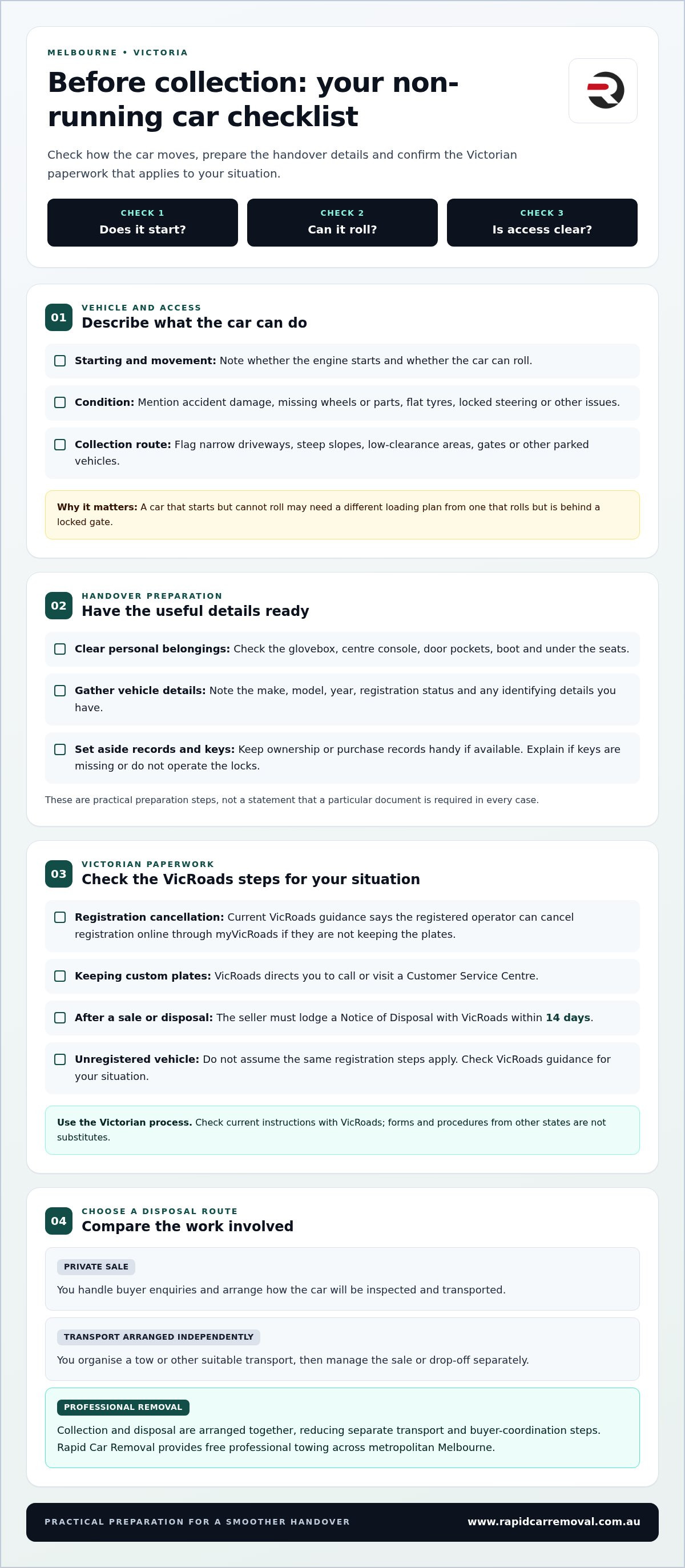
Arrange collection safely: a step-by-step Melbourne checklist
A clear collection plan starts with the car’s exact condition and location. A vehicle that won’t start may still roll and steer. One that can’t roll, has locked steering or sits in a restricted space needs a different loading plan. Share those details upfront so the collection arrangements reflect the actual job.
How to prepare the location for a non-running vehicle pickup
Before collection, look at the space around the car and the route to it. Where practical, clear loose items and identify gates, steep driveways, low clearances, tight corners or restricted parking. Don’t try to start or move the vehicle if it may be unsafe. If it can’t be moved safely, leave it where it is and explain the issue.
- Gather the vehicle details. Note the make, model, registration status and any known damage or missing parts.
- Describe how it moves. Say whether it starts, steers and rolls. A car that starts but has locked wheels is different from one that won’t start but can roll.
- Explain access. Give the collection location and flag obstacles such as a narrow driveway, slope, gate or blocked parking area.
- Prepare for handover. Remove personal belongings and have any available keys and ownership details ready.
- Confirm the arrangement. Before the vehicle is handed over, confirm the car’s details, collection plan and any agreed payment terms.
Be specific rather than guessing. For example, “the engine won’t start, but the wheels turn” gives a clearer picture than simply calling the car immobile. Mention if the keys are missing, the steering is locked or the car is partly blocked in. Don’t put yourself at risk to test whether it can move.
What happens during handover and after the car leaves
At handover, match the vehicle to the details agreed beforehand and make sure you understand the collection and payment arrangements. Keep any paperwork provided with your records. If a detail has changed since the collection was arranged, raise it before the vehicle is loaded.
There’s also a Victorian registration step to finish. Check current VicRoads instructions for your circumstances, including how to cancel registration and what to do with the number plates. VicRoads guidance says the registered operator must cancel registration before disposal. A Notice of Disposal must also be lodged within 14 days of the sale or disposal. Use VicRoads’ current process rather than instructions written for another state.
If you’re weighing up selling as well as arranging removal, the broader cash for cars Melbourne guide covers related selling considerations. For a non-running vehicle in metropolitan Melbourne, get in touch to discuss collection with Rapid Car Removal, which provides free professional towing and assistance with paperwork.
Dispose of a non-running car in Melbourne with less hassle
Start with the facts: assess the car’s condition, consider how much transport planning each option needs, and gather the details that explain its situation. Then check the current Victorian registration and number-plate steps with VicRoads. You can plan disposal without assuming the car must be running or easy to move before arranging collection.
If you’re working out how to dispose of a car that doesn't run, professional removal can bring collection and disposal together. Rapid Car Removal handles unwanted cars in any condition across metropolitan Melbourne. Its service includes instant quotes, vehicle collection, free professional towing and assistance with paperwork.
How Rapid Car Removal helps with non-running vehicles
A car doesn’t have to be in working order to be considered for removal. Share what you know about its condition and access, then get an instant quote. Rapid Car Removal provides free professional towing and collection across metropolitan Melbourne, so you don’t need to drive the vehicle to a buyer or disposal location. Assistance with paperwork is also included in the collection process.
What details to have ready for a quote
Useful details help describe the vehicle clearly from the outset. Note the make and model, where it’s located and its general condition. Be direct about what it can do: does it start, roll or steer? Mention accident damage, missing parts or access issues such as a tight driveway or restricted parking. You don’t need to diagnose the fault. An accurate description is more helpful than a guess.
- Vehicle: Make, model and any known damage or missing parts.
- Movement: Whether it starts, rolls and steers, or is unable to move.
- Location: The collection address and any restrictions around access.
- Registration: Whether it’s registered, if you know its status.
With those details ready, compare the practical effort involved. A private sale may mean coordinating buyer enquiries and transport separately. Removal combines collection with the disposal process, reducing those separate steps. Choose an option that matches the vehicle’s condition and location, as well as your priorities.
Before and after handover, use current VicRoads guidance to complete the registration and plate steps that apply to your circumstances. Keep any paperwork you receive with your records. Rapid Car Removal can assist with paperwork as part of collection, while you remain responsible for checking and completing any Victorian requirements that apply to you.
Have the car’s details and location handy? Share your vehicle details and request an instant quote to get started.
Take the next step towards clearing the car
A non-running car can feel like a problem that keeps getting postponed. You don’t need every mechanical question answered before taking the next step. Start with what you know, be upfront about what you’re unsure of, and use those details to make a practical disposal plan.
If you’re deciding how to dispose of a car that doesn't run, focus on describing the vehicle honestly and considering what would make handover manageable at its location. A quote request gives you a clear starting point for discussing collection and the next steps.
Rapid Car Removal provides instant quotes for unwanted vehicles in any condition, with free professional towing and removal across metropolitan Melbourne. Collection includes assistance with paperwork, so you can discuss the vehicle and its handover in one place. Request an instant quote for your non-running car and take the first step towards getting it sorted.
Frequently Asked Questions
Can I dispose of a car that doesn’t run in Melbourne?
Yes. A car that won’t run can still have disposal options in Melbourne; being unable to drive it is a transport issue, not proof it can’t be transferred. A minor starting fault differs from severe damage or missing wheels. Before choosing a route, describe where the car is parked, whether it can roll and whether narrow access or other obstacles could affect collection.
How do I get rid of a car that won’t start?
To decide how to dispose of a car that doesn't run, note its make, model, location and known symptoms, then compare a private sale with removal. Explain whether the engine turns over or the car is completely immobile, and share access limits early. Don’t attempt a push-start, tow or manual move if the vehicle, slope or surroundings could make it unsafe.
Do I need to cancel my car registration when I dispose of it in Victoria?
Yes. For a Victorian-registered vehicle, the registered operator must cancel its registration before disposal. Plate arrangements can depend on your circumstances, so check current VicRoads instructions before acting, particularly if you want to keep custom plates. Don’t rely on NSW or South Australian forms or timelines for a Melbourne vehicle. VicRoads is the source for the relevant Victorian process.
Can an unregistered car be removed in Melbourne?
Yes. Registration status and whether a car runs are separate issues. An unregistered car may still be collected, but its location and access matter for planning. Explain whether it’s on private property or the street, and whether it can roll or steer. Rapid Car Removal handles unwanted vehicles in metropolitan Melbourne. Find details about cash for unregistered cars in Melbourne and have the car’s status ready to describe.
What should I remove from my car before disposal?
Take out personal belongings, including items tucked in the glovebox, door pockets, centre console, boot and under the seats. Check the spare-wheel well, sun visors and any storage compartments too. Remove documents or accessories you want to keep, such as toll tags or a phone mount. If possible, gather the keys and any vehicle details you have, then check the cabin once more before handover.
Can I get a car removed if it is stuck in a driveway?
A stuck car may still be removable, but the collection plan depends on its position and condition. Explain if the driveway is steep, narrow or has low overhead clearance, and say whether the car can roll or steer. Mention anything blocking access, such as another vehicle or a closed gate. Don’t try to push, jack up or start it if that could put anyone at risk.
What happens to a car after it is collected for disposal?
After handover, the vehicle follows the disposal arrangement agreed for its condition. Its next destination may differ depending on whether it has usable parts, damage or other issues, so don’t assume every car follows the same recycling path. Keep any handover records you receive. For a Victorian-registered vehicle, check VicRoads guidance and complete the registration steps that apply to your circumstances.


