

Searching “who buys cars that are not running melbourne” because your car won’t start? It can be hard to sell a vehicle when it can’t be driven to a buyer, especially if it’s stuck in a driveway or parked off-road. Specialist cash-for-cars buyers and wreckers in Melbourne can assess non-running vehicles and arrange removal.
Rapid Car Removal buys cars in any condition across metropolitan Melbourne, with free professional towing and removal. You don’t need to arrange a separate tow or get the car running before selling it.
This guide explains who may buy your non-running car, what can affect your options and which vehicle details help produce a useful quote. You’ll also learn what to prepare for collection and how to make the sale and removal process more straightforward. Sharing accurate details about the car’s condition and location helps with the quote and collection arrangements.
Key Takeaways
- For who buys cars that are not running melbourne, the main options include cash-for-cars buyers, car wreckers and private buyers. Their collection arrangements can differ.
- A car that won’t start may still have value. Its condition and potential for salvage can affect a buyer’s assessment.
- Compare options by considering the vehicle’s condition, who arranges transport and how much organising you’ll need to do.
- Before collection, remove personal belongings and check the boot, glovebox and other compartments.
- Sharing clear vehicle details helps the buyer assess the car and plan collection.
Who buys cars that aren’t running in Melbourne?
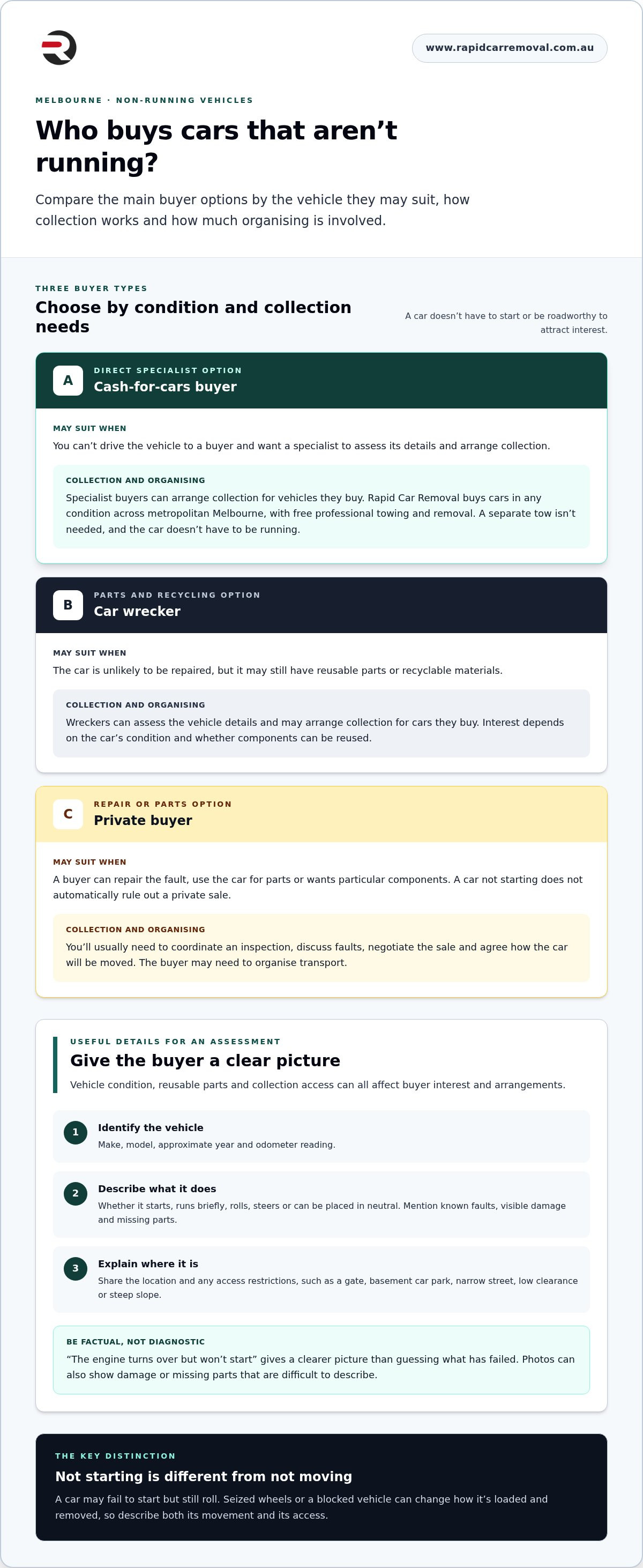
A car that won’t start or move can be harder to sell because a test drive and drive-away handover aren’t possible. That doesn’t rule out a sale. Your main options are specialist cash-for-cars buyers, car wreckers and private buyers. The right fit depends on the vehicle’s condition, whether its parts can be reused and how it will be collected.
Start by describing the car clearly. Useful details include its make and model, approximate year, odometer reading, known faults and any accident damage. Explain whether it starts, whether it can roll and where it’s parked. Photos can also help show its condition. This information helps a buyer assess whether the car may suit repair, parts recovery or recycling, and what collection arrangements it needs.
A car that’s beyond practical repair may still contain reusable components or recyclable materials. The vehicle recycling process can involve recovering usable parts and processing materials, so a vehicle’s potential value isn’t determined solely by whether it can be driven.
Cash-for-cars buyers and car wreckers
Specialist buyers and wreckers are a direct option if you can’t drive the vehicle to them. They can assess the details you provide and arrange collection for vehicles they buy. Wreckers may suit cars that are unlikely to be repaired, particularly when parts remain reusable. If your vehicle is no longer roadworthy or is at the end of its life, cash for junk cars in Melbourne is a relevant buyer category to consider.
Rapid Car Removal buys unwanted cars in any condition across metropolitan Melbourne and includes professional towing and removal. The car doesn’t need to be driven to a buyer, and you don’t have to organise a separate tow for a vehicle that can’t move under its own power.
Could a private buyer take a non-running car?
Yes. A private buyer may be interested if they can carry out repairs, use the car for parts or organise transport. This can suit a vehicle with a fixable fault or one with parts a particular buyer wants. A private sale isn’t automatically unsuitable just because the car won’t start.
However, you’ll usually need to coordinate an inspection, discuss the faults, negotiate the sale and agree on how the vehicle will be moved. That can mean more steps, especially if the car is difficult to access or needs towing. Compare that effort with a specialist buyer that can assess a non-running vehicle and arrange removal. If you’re weighing up who buys cars that are not running melbourne, consider how well the buyer’s process fits the car and its collection needs, not just the fact it won’t start.
How do Melbourne buyers assess a car that won’t start?
A non-running car can’t be driven under its own power, but that doesn’t automatically make it valueless. A buyer may consider its overall condition, whether components can be reused and what’s involved in collecting it. Each vehicle is different, so an assessment depends on the details of that specific car.
Be factual rather than trying to diagnose the fault. “The engine turns over but won’t start” gives a clearer picture than guessing that the fuel pump has failed. If you’re researching who buys cars that are not running melbourne, accurate information helps the buyer understand the vehicle and its recovery needs before collection is arranged.
What details help a buyer assess the vehicle?
Share the make, model, approximate year and current location. Explain what happens when you try to start it, whether it runs briefly, and whether it can roll or steer. Mention visible damage, missing parts and known mechanical problems. If you don’t know the cause of a fault, say so rather than guessing.
- Vehicle basics: Make, model and approximate year.
- Starting and running: Whether it starts, runs or stops shortly after starting.
- Movement: Whether it can roll, steer or be placed in neutral.
- Condition: Visible damage, missing components and known faults.
- Location: Where it’s parked and any access restrictions.
Photos can show details that are difficult to describe, such as a damaged panel or missing wheel. The Australian Design Rules for vehicles cover national design requirements, but they aren’t a valuation guide. For an assessment, focus on the car’s actual condition and what’s present now.
Why condition and collection access matter
Damage, how complete the vehicle is and the potential for reusable parts can influence buyer interest. A car with an engine fault but intact body panels differs from one with major collision damage or missing components. Neither description guarantees a particular offer. Clear details give the buyer a more accurate basis for assessing the vehicle.
Be precise about the difference between not starting and not moving. A car may fail to start but still roll, while another may have seized wheels or be blocked in. That distinction affects how it can be loaded and removed. Include access details too, such as whether it’s in a driveway, behind a gate, in a basement car park or on a narrow street. Mention low clearance, steep slopes or anything else that could affect access.
Clear information helps Rapid Car Removal provide an instant quote and plan professional collection across metropolitan Melbourne. To share the vehicle’s condition and location, send through your car details.
Which buyer is the better fit for your non-running car?
A car doesn’t have to start or be roadworthy to attract interest. The key question is which buyer suits its condition and can manage the transport involved. A private buyer may want a repair project, while a wrecker may be interested in reusable parts. A specialist cash-for-cars buyer can combine an assessment with vehicle collection, reducing the separate organising you need to do.
Use this comparison as a starting point. The exact arrangement depends on the vehicle and the buyer.
| Buyer type | Vehicle that may suit | Transport and seller coordination |
|---|---|---|
| Specialist cash-for-cars buyer | Unwanted, damaged, old or non-running cars | The buyer can assess the vehicle and arrange professional collection. The seller shares condition and location details and agrees the handover. |
| Car wrecker | Cars unlikely to be repaired, including vehicles with parts that may be reusable | Collection arrangements depend on the buyer. The seller may need to coordinate transport and access. |
| Private buyer | A car that suits someone able to repair it, use parts or organise transport | The seller usually coordinates inspection and negotiation, then agrees with the buyer how the car will be moved. |
When a specialist buyer may suit your situation
If the car is damaged, old or won’t start, combining the quote and collection can make the sale more straightforward. Rapid Car Removal buys unwanted vehicles in any condition and provides free professional towing and removal across metropolitan Melbourne. Its cash for cars in Melbourne service brings assessment and removal together, rather than leaving you to arrange a separate tow.
This can be a practical fit if the vehicle can’t be driven to a buyer or you want fewer logistics to manage. Share an accurate description and location so the buyer can assess the car and plan collection around its condition.
Questions to compare before accepting an offer
Before agreeing to a sale, understand what the quoted offer covers. Check whether removal is included or arranged separately, and make sure the payment and sale paperwork process is clear before handover. The collection plan should also reflect the car’s actual condition and access, particularly if it can’t roll or is parked somewhere difficult to reach.
These details help you compare the full process, not just the offer. If a quote assumes the car can move but it can’t, collection arrangements may need to be revisited. Be upfront about faults and access from the start.
For an option that combines a quote with free professional removal, discuss your non-running car with Rapid Car Removal.
How to prepare a non-running car for collection in Melbourne
A little preparation can make collection easier, especially if the car won’t start or move. Give the buyer a clear picture of its condition and location, agree on the collection plan, then prepare the vehicle and handover details. You don’t need to get the car running just to arrange removal.
Share accurate condition and access information
Tell the buyer whether the car starts, runs, rolls and steers. Mention damaged or missing parts and known mechanical problems, but don’t guess at the cause of a fault. Explain exactly where it’s parked and flag obstacles such as a narrow driveway, locked gate, steep slope or underground car park. These details help plan collection for the vehicle as it is.
Be clear about whether the car can roll, not just whether it can start. A vehicle that starts but has seized wheels may need a different collection plan from one that won’t start but can still be moved. Don’t attempt to start or shift an unsafe vehicle for the sake of collection. Accurate information is more useful than taking a risk.
Prepare for the handover
Once collection is agreed, remove your belongings and make any keys you have available. Gather relevant vehicle and ownership documents. If you need to understand what applies to your circumstances, check current Victorian registration or transfer guidance with VicRoads. Requirements can depend on the vehicle and sale, so avoid relying on assumptions.
- Describe the car: Share its make, model, approximate year, known faults and whether it starts, rolls or steers.
- Give the exact location: Include access instructions and any restrictions that could affect a tow vehicle.
- Agree on collection: Confirm the timing and practical arrangements, including how the car will be accessed and loaded.
- Get the handover ready: Remove personal items, check the boot, glovebox and other compartments, and set aside keys and relevant documents.
- Confirm payment steps: Understand how payment and paperwork will be handled before the vehicle leaves.
Take a final look through the cabin, under the seats and in storage compartments. Items can be easy to miss when you’re focused on the car’s mechanical condition. If the vehicle is parked in a shared or restricted area, account for access in the collection plan to avoid preventable issues.
For a non-running car in metropolitan Melbourne, Rapid Car Removal includes professional towing and removal as part of its service. Sharing accurate condition and location details helps move the quote and collection arrangements along. If you’re searching who buys cars that are not running melbourne, you can share your car details and arrange collection.
Sell your non-running car to Rapid Car Removal in Melbourne
A non-running car doesn’t need to be driven to a buyer to be sold. Rapid Car Removal is a Melbourne-based buyer of unwanted cars in any condition, with free professional towing and removal across metropolitan Melbourne. Share the vehicle details, receive an instant quote and, if you choose to proceed, arrange professional collection. The car’s condition and location help shape the arrangements, so describe both clearly from the outset.
If you’ve searched “who buys cars that are not running melbourne”, the practical answer is a buyer who can assess the car and handle its removal. Rapid Car Removal’s collection service means you don’t need to organise a separate tow for a vehicle that can’t be driven.
What to include when requesting a quote
Give a clear, accurate snapshot of the car. You don’t need to diagnose a fault. Explain what happens when you try to start it, whether it runs at all, and whether it can roll or steer. Mention damage or missing parts, even if they seem minor. Clear information helps the quote reflect the vehicle you’re selling and supports practical collection planning.
- Vehicle details: Make, model and approximate year.
- Condition: Why it isn’t running, what you know about its faults, and any visible damage or missing parts.
- Collection location: The Melbourne suburb or address where the car is parked.
- Access: Whether it’s in a driveway, behind a gate or in an underground car park, and whether a tow vehicle can reach it.
Be straightforward if you’re unsure about a mechanical issue. “It stopped running and hasn’t been checked” is more useful than guessing at a cause. Likewise, distinguish between a car that won’t start but can roll and one that can’t be moved.
What happens next?
Once you’ve shared the details, Rapid Car Removal provides an instant quote based on the information supplied. If you decide to proceed, arrange professional collection with the team. Free towing and removal are available across metropolitan Melbourne, so the vehicle’s inability to drive doesn’t require you to organise a separate towing job.
- Share the details: Describe the vehicle, its condition and its location.
- Review the quote: Consider the offer and clarify the proposed collection arrangements.
- Prepare the handover: Remove personal belongings and gather relevant vehicle documents and any keys you have.
- Finalise the sale: Understand the payment steps and paperwork process before the vehicle is collected.
Rapid Car Removal can assist with sale paperwork, helping you understand the handover process alongside collection. Share accurate information early, then agree on the arrangements before the vehicle leaves. To discuss your car and its collection, contact Rapid Car Removal about your non-running car.
Choose the next step that clears the way
A non-running car can take up space and attention, but identifying your priorities can make the next move clearer. You could explore a private sale or choose a process centred on an agreed sale and handover. There’s no one-size-fits-all answer. Choose the route that fits your priorities and the effort you’re prepared to put in.
If you’re still wondering who buys cars that are not running melbourne, focus on a buyer whose process fits your car’s condition and collection needs. You don’t have to solve every detail before making an enquiry. Start with what you know about the vehicle, then take the next step.
Talk with Rapid Car Removal about your non-running car and arrange a straightforward handover. Your car may not start, but you can still get the process moving.
Frequently Asked Questions
Who buys non-running cars in Melbourne?
Specialist cash-for-cars buyers, car wreckers and some private buyers purchase non-running cars in Melbourne. A wrecker may be interested in reusable parts, while a private buyer might want a repair project. If you’re searching for who buys cars that are not running melbourne, Rapid Car Removal buys unwanted vehicles in any condition. The car’s state, parts and collection access help determine the practical fit.
Can I sell a car that does not start?
Yes, you can sell a car even if it won’t start. You don’t need to get it running to request an assessment. Explain what happens when you try to start it, and say if the fault hasn’t been diagnosed. For example, describe whether the engine turns over or nothing happens. This helps the buyer understand the vehicle without relying on guesses about the cause.
Will a car wrecker collect a non-running car?
A car wrecker may collect a vehicle it’s buying, including one that can’t be driven. Collection arrangements depend on the car’s condition and access. Explain whether it can roll or steer, and mention issues such as seized wheels or a tight parking area. Rapid Car Removal includes professional vehicle removal for cars it buys, so you don’t need to drive the vehicle to a yard.
Do I need to pay for towing when selling a non-running car?
Not necessarily. Towing costs depend on the buyer and sale arrangement, so understand whether removal is included before agreeing to sell. Rapid Car Removal provides free professional towing and removal across metropolitan Melbourne for vehicles it buys. This means you don’t need to organise a separate tow. Give an accurate description of the car and its location so collection arrangements reflect the vehicle and access conditions.
What information should I give a buyer when requesting a quote?
Provide the make, model, approximate year and collection location, then describe the fault in plain terms. Mention whether the car starts, runs, rolls or steers, along with any visible damage or missing parts. The odometer reading and clear photos can also help show its condition. If you don’t know why it stopped running, say so rather than stating a suspected fault as fact.
Can I sell a damaged car that cannot be driven?
Yes, a damaged car that can’t be driven may still interest a specialist buyer or wrecker. Describe the damage accurately, including which parts are affected and whether anything is missing. For example, distinguish between a car with panel damage that still rolls and one with a damaged wheel that prevents movement. Don’t try to drive an unsafe vehicle for an inspection. Explain its condition and discuss collection instead.
What paperwork do I need to sell a non-running car in Victoria?
Paperwork depends on the car’s registration status and who buys it. VicRoads guidance states that private sales of registered vehicles require the seller to provide a valid roadworthy certificate, while a sale to a licensed motor car trader or wrecker doesn’t require one. For an unregistered private sale, check VicRoads’ current advice on registration cancellation, plates and disposal paperwork. Keep a sale receipt and proof of ownership for your records.


