

A non-running car can still be disposed of in Melbourne. In Victoria, owners must notify VicRoads when a car is sold, transferred or disposed of. A certificate of destruction for a car in Victoria does not update the vehicle’s registration record.
It’s understandable to expect a formal certificate when a car is scrapped. The key distinction is what the document records and what you need to do about the vehicle’s registration.
This article explains what a certificate of destruction records, who may receive one, and how Victorian disposal rules apply when your car won’t run. You’ll also learn what to consider before arranging removal, so you can move on from the vehicle without confusion about the paperwork.
Key Takeaways
- A vehicle destruction document and a VicRoads disposal notification serve different purposes, so don’t treat one as a substitute for the other.
- Understand the details a certificate may record, including what was destroyed and when and where the destruction took place.
- Find out who receives a certificate and what the available information says about when it is issued.
- A car that won’t run can still be removed for disposal; abandoning it on a public road, nature strip or someone else’s property is illegal in Victoria.
- See how Rapid Car Removal’s Free Car Removal can help when an unwanted car needs to be taken away.
What a certificate of destruction is
A certificate of destruction is a document recording that identified property has been destroyed or disposed of. For a vehicle, it may provide written evidence that the car was dismantled or otherwise processed, rather than remaining available for road use. Its exact meaning depends on who issued it and what process it records.
In Victoria, don’t assume the phrase refers to a single government-issued car document. A recycler’s written confirmation of destruction is different from a vehicle registration record or a transfer notification. Read the issuer, vehicle details and stated outcome together. For example, a statement confirming collection doesn’t necessarily confirm destruction.
The term also appears in a separate Victorian context: public records. Public Record Office Victoria identifies its Disposal Standard as PROS 22/04. That standard concerns the authorised disposal of public records, not a certificate for scrapping a privately owned car. The distinction matters because a rule or document about government records shouldn’t be treated as a vehicle-scrapping requirement.
A destruction record can help show what happened to a car after it left the owner’s possession. It may identify the vehicle, date and location of destruction, items handled, and chain of custody. These details help distinguish processing from collection or storage and give the owner a clearer record of the disposal.
What happens to a car with finance, a lien or outstanding fines when it is destroyed in Victoria? Destruction does not itself settle finance, remove a lien or cancel a fine. Those obligations remain separate from the physical disposal record, which documents the vehicle’s handling, not the discharge of a debt.
How can you check that a Victorian car wrecker or recycler is licensed and legitimate? Ask for the operator’s registered business name and details of any licence or permit relevant to its activity, then verify them with the Victorian authority that issues them. Make sure the paperwork identifies the operator and vehicle, rather than relying on a verbal promise.
Keep the distinction clear: a certificate or receipt can document a vehicle’s fate, while registration and financial records deal with different matters. Before relying on a document, check its issuer, the vehicle identified, the action recorded and the date. If it confirms collection only, don’t treat it as proof that registration has ended or separate obligations have been settled.
What information appears on the certificate
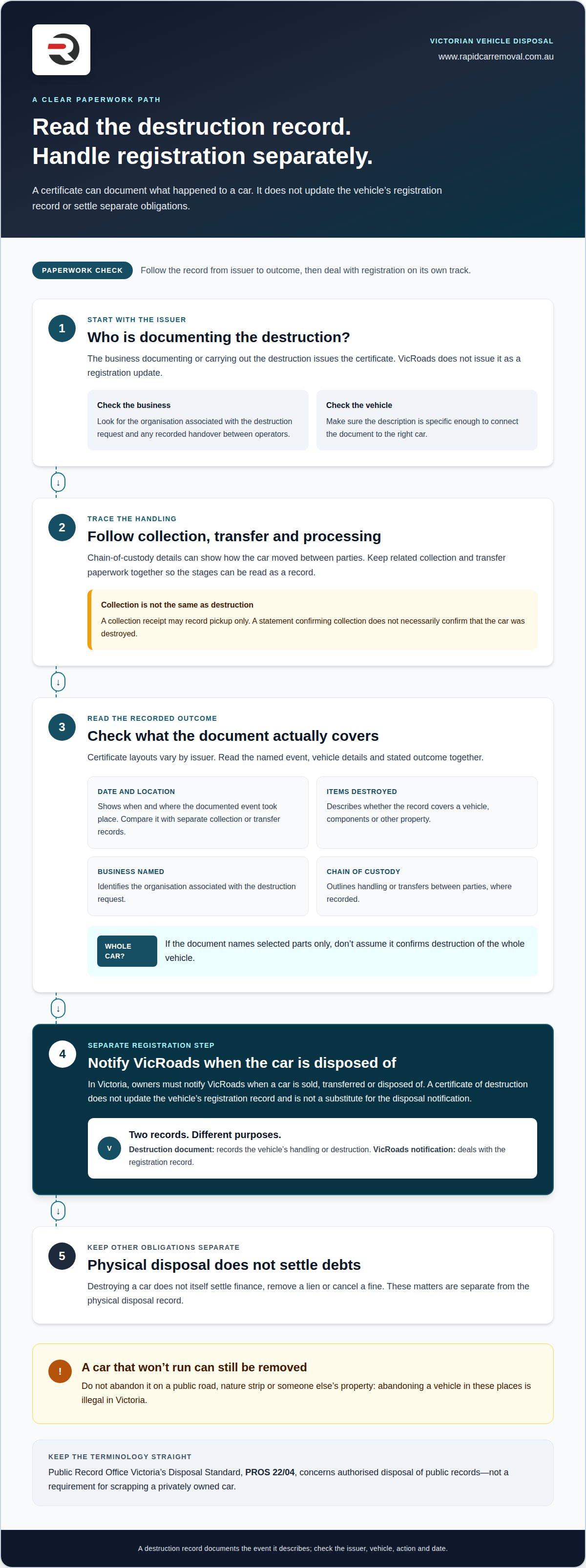
A certificate of destruction typically identifies the requesting business, destruction date and location, items destroyed, and chain of custody. These details explain what the document records and how the vehicle moved from collection to its stated outcome. Layouts vary by issuer, so read it as a record of the process described, not as a standard form with identical fields everywhere.
Start with the business named on the document. It should be clear which organisation requested or arranged the destruction. If another operator handled the vehicle, the paperwork may also describe that handover. Together, the names and steps can show who was responsible at each stage. A collection receipt may record pickup only, not later destruction.
The date and location place the recorded event in time and place. For example, a document could state that a vehicle was destroyed at a named facility on a particular date. Compare this with any separate collection or transfer record you hold. Different collection and destruction dates may reflect separate stages, but the document should clearly state the event it records.
The items destroyed section should describe what the certificate covers. It may identify a vehicle, components or other property. If the paperwork refers only to selected parts, don’t assume it confirms destruction of the whole car. A clear description distinguishes whole-vehicle disposal from dismantling for salvageable parts.
- Requesting business: identifies the organisation associated with the destruction request.
- Date and location: records when and where the documented event took place.
- Items destroyed: describes the vehicle or other property covered.
- Chain of custody: outlines the handling or transfer between parties.
Chain-of-custody information matters when different businesses handle collection, transport and processing. Named parties or recorded handovers can make the vehicle’s route easier to follow. If the document names only one stage, it provides a narrower account. Keep related paperwork together so the certificate can be read alongside records of earlier steps.
Check that the vehicle description is specific enough to distinguish it from another car. A registration number, make, model or other identifying detail can connect the document to the correct vehicle. If a detail is wrong, ask the issuing business to explain or correct its record. An unclear description alone doesn’t prove the vehicle was processed incorrectly.
Use the certificate for what it says: evidence of the recorded destruction process. It does not automatically establish that registration records changed or that finance and other obligations ended. If you’re organising a vehicle’s removal and need to discuss the paperwork, get in touch about the disposal process.
When and to whom a certificate is issued
In Victoria, a destruction certificate is a record provided by a business documenting a vehicle’s destruction. It is separate from the registration notification handled through VicRoads.
Issuing the certificate
The business documenting or carrying out the vehicle’s destruction issues the certificate. VicRoads does not issue it as a registration update. The issuer is responsible for the details recorded, such as the vehicle identification and action completed.
Ask which business will issue the document and what event it records. The company collecting a car may not be the operator that later dismantles it. If different businesses handle these stages, the record should make clear which organisation is responsible for the stated destruction.
Getting a certificate for your car
Request a certificate from the business responsible for documenting the car’s destruction. Provide enough information to identify the vehicle, such as its registration details or make and model, and ask how the document will be provided.
For example, if a business collects a damaged car and sends it for processing, ask whether its paperwork confirms collection only or destruction as well. Keep the response with any collection record. This distinction clarifies what has been disposed of and what the document actually proves.
How do you get a certificate of destruction for your car in Victoria? Request it from the business documenting the destruction, and make sure it identifies your vehicle and the event recorded. A collection receipt is not proof of destruction unless it says destruction occurred.
Issue timing and recipients
The certificate is issued after the destruction event it records, not simply because a vehicle has been collected. The responsible business provides it to the person or organisation that requested or arranged the destruction. For a privately owned car, that will generally be the owner who arranged its disposal.
Timing depends on when processing is completed and when the issuer prepares its record. A car collected on one date may be destroyed later, so the collection date and destruction date can differ. Read the date on the certificate as the date of the event it records.
Keep the certificate with any sale, transfer or collection paperwork. VicRoads notification is a separate step when a vehicle is disposed of, so a destruction document alone does not prove that registration records have been updated. The certificate records the handling described by its issuer; registration records address the vehicle’s status with VicRoads.
Whether a certificate is needed to scrap a car
For a Victorian car disposal, the key formal step for the owner is notifying VicRoads that the vehicle has been disposed of. A certificate of destruction records a business’s handling of the vehicle; it does not update the registration details. Keep these purposes separate when arranging scrap disposal and completing the paperwork.
Victoria’s disposal rule requires owners to notify VicRoads when a car is sold, transferred or disposed of. A certificate can document what happened to the vehicle, but it does not replace that notification. For example, a destruction document may describe the car’s fate while leaving registration records unchanged.
So, do you need a certificate before scrapping a car? The relevant owner action is to notify VicRoads of the disposal, while a certificate may provide a separate record of destruction. Don’t mistake a collection receipt or destruction document for confirmation that VicRoads has updated the registration.
Scrap transactions also have a payment rule. In Victoria, cash payments for scrap metal and vehicle parts have been prohibited since 2018. Payments for cars are made by bank transfer. This distinction matters when a vehicle is sold for scrap: the transaction involves a car, while separate scrap-metal and vehicle-parts rules apply to those materials.
Before the vehicle leaves, keep paperwork identifying the car and recording the transaction or collection. A registration number, make or model can link a receipt or destruction record to the correct vehicle. Retain the documents together so you can distinguish the sale or transfer record from later confirmation of processing.
- VicRoads: notify it when the car is disposed of.
- Certificate: use it as a record of the destruction described by its issuer.
- Payment: car payments are made by bank transfer; cash payments for scrap metal and vehicle parts are prohibited in Victoria.
Don’t leave an unwanted vehicle where it creates a separate legal problem. In Victoria, abandoning a vehicle on a public road, nature strip or someone else’s private property is illegal. Arrange proper disposal instead of leaving a non-running car somewhere it may be treated as abandoned.
Recycling can involve collection, dismantling and processing, but those stages aren’t interchangeable on paperwork. A collection record shows collection; a destruction record should describe destruction. Keep each document with its date and vehicle details. Retaining an electronic copy alongside any paper documents can make the records easier to access.
In practical terms, arrange disposal, retain the relevant records and notify VicRoads. A certificate can support your records, but registration notification remains a separate responsibility.
Who can issue a certificate of destruction for a vehicle in Victoria?
For a private vehicle in Victoria, the relevant document is a record from the business handling or documenting its destruction. VicRoads manages vehicle registration records, so its disposal notification is separate from a recycler’s destruction record.
There is an important distinction between a business-issued document and an official government certificate. A company can provide written evidence describing the vehicle and the work it says it completed. The paperwork should identify its issuer and clarify whether it records collection, dismantling or destruction. These terms describe different stages.
Ask the operator responsible for processing the car for a document stating what happened. If one business collects the vehicle and another processes it, the collection business may record only the handover. The operator that performs or documents the destruction is the relevant party for a record of that work.
Keep the registration process separate. In Victoria, owners must notify VicRoads when a car is sold, transferred or disposed of. A recycler’s document can support your records, but it does not update the registration record. For example, keep a destruction certificate alongside proof of the separate VicRoads notification.
Before relying on a document, review the operator’s details and the vehicle description. A clear record should connect the paperwork to your car and explain the event it describes. Look for details such as:
- Issuer: the business responsible for the record.
- Vehicle: identifying details that distinguish your car.
- Action: whether the document describes collection, dismantling or destruction.
- Date: when the recorded action took place.
These details help you spot a mismatch. For instance, paperwork naming the correct vehicle but describing collection only does not establish that destruction occurred. If the wording is broad, ask the issuer what its statement covers. Keep the answer with the paperwork to provide useful context later.
Don’t treat a business name or certificate heading as proof of government approval. The document’s value depends on who issued it and what it records. Check the operator’s business details and any relevant licence or permit with the Victorian authority responsible for issuing it. This is particularly useful if the paperwork claims a specific approval.
For a car being scrapped, request the record from the business handling its destruction and retain it with the disposal paperwork. Then complete the separate VicRoads notification. If you need help discussing the paperwork for a vehicle disposal, contact the team about your car’s removal.
Rapid Car Removal
Rapid Car Removal helps Melbourne vehicle owners arrange removal of unwanted or non-running cars. If your main concern is getting the vehicle collected, Free Car Removal can handle that practical step, while your VicRoads disposal notification remains separate.
Keep collection paperwork with your vehicle records and distinguish it from a certificate documenting destruction. For trucks needing removal, Rapid Car Removal also offers Scrap Truck Removal. Choose the service that fits the vehicle, and keep the paperwork you receive alongside your records.
If you’re ready to discuss removing your vehicle, contact Rapid Car Removal.
Make your next step clear
Before arranging the handover, decide what you need the paperwork to do for you. A certificate of destruction for a car in Victoria can record a vehicle’s documented end-of-life handling, while your next steps should reflect the car’s condition and your disposal plans. Keep the process practical: know which vehicle is being collected, who is handling it and what records you expect from the handover.
Rapid Car Removal helps with unwanted vehicles through Cash for Cars, Free Car Removal and Scrap Truck Removal. Choose the option that fits the vehicle you need removed, then handle your registration responsibilities separately from the removal arrangement.
Ready to discuss a vehicle handover? Contact Rapid Car Removal and take the next step with confidence.
Frequently Asked Questions
Can I dispose of a non-running car in Melbourne?
Yes, a non-running car can be removed for disposal in Melbourne. Rapid Car Removal accepts unwanted vehicles in any condition and offers Free Car Removal. Before collection, make sure the vehicle is on property where it can be accessed safely. Keep your transaction and collection paperwork, then handle the VicRoads notification separately if the car is disposed of.
Do I need to do anything with VicRoads when I dispose of my car?
Yes. Victorian owners must notify VicRoads when a car is sold, transferred or disposed of. For example, if you hand an old car to a recycler, the handover document and VicRoads notification serve different purposes. Keep a disposal record and complete the relevant notification process, so registration is dealt with separately from physical removal.
How do I dispose of a car in Victoria?
Arrange legitimate vehicle collection or disposal, keep paperwork linking the transaction to your car, and notify VicRoads of the disposal. Don’t leave the vehicle on a public road, nature strip or someone else’s private property, as abandoning it there is illegal in Victoria. If your car won’t start at home, Rapid Car Removal can arrange its removal without you driving it to a facility.
Should I worry if I didn’t receive a certificate of destruction?
Not automatically. A destruction certificate is a business record, and a collection receipt may document a different stage. Ask the business that handled the vehicle what paperwork it provides for the work recorded. Keep the response with your sale or collection documents. Separately, complete the required VicRoads disposal notification, since a certificate does not update registration.
What is a certificate of destruction for a car in Victoria, Australia?
It is a business-issued document recording that a vehicle was destroyed or processed as described. It may identify the car, destruction date and location, items involved and chain of custody. For example, paperwork recording collection alone does not necessarily confirm destruction. Treat the document as evidence of the event recorded by its issuer, not as a VicRoads registration update.
What documents are required to destroy or deregister a car in Victoria?
Keep paperwork identifying your vehicle and recording its sale, transfer, collection or destruction. The exact documents depend on the transaction and registration step involved. A destruction certificate does not replace notification to VicRoads when a vehicle is disposed of. If the car is registered, keep its identifying details and disposal records together to complete the relevant notification accurately.
Does Victoria require a certificate of destruction to scrap or dismantle a car?
The key owner step in Victoria is notifying VicRoads when the car is disposed of; a business-issued destruction record serves a separate purpose. Don’t assume a certificate deregisters the car. If a recycler provides paperwork, check whether it confirms collection, dismantling or destruction, and retain it with your disposal records.
How much does car removal or vehicle destruction cost in Victoria?
Rapid Car Removal’s Free Car Removal includes free vehicle removal. Any cash offer depends on the vehicle and is provided after a quote request. The vehicle’s condition and the work involved are relevant to its assessment. Request a quote to understand the offer before agreeing to the transaction.


