

A Melbourne council can take action against an unregistered car left on a public street, and some councils can impound it. Rules vary by council, and councils generally have no jurisdiction over vehicles parked on private property. Leaving a car unused does not necessarily prevent enforcement, so respond promptly to a council fine for an unregistered car parked on a street in Melbourne.
Facing a fine while working out what to do with a car you cannot legally drive can be stressful. The right next step depends on where the vehicle is, what the notice says and whether an exemption or defence applies.
This guide explains when council action may apply, how local rules differ and what to do if you want to challenge a notice. It also covers a practical option for a car that no longer belongs on the street: selling it to a wrecker without driving it there.
Key Takeaways
- Find out whether the vehicle is on a public road or private property, as that can affect council action.
- Understand how section 7 of Victoria’s Road Safety Act 1986 applies and when an exemption or registration permit may matter.
- Check the rules for your local council, including how it handles reports, notices and impounded vehicles.
- Don’t assume an unused, unregistered car can stay on the street indefinitely; the circumstances and council rules affect what happens next.
- If the car is no longer worth keeping, learn how selling it to a wrecker can help you clear it without driving it.
Defences and exemptions
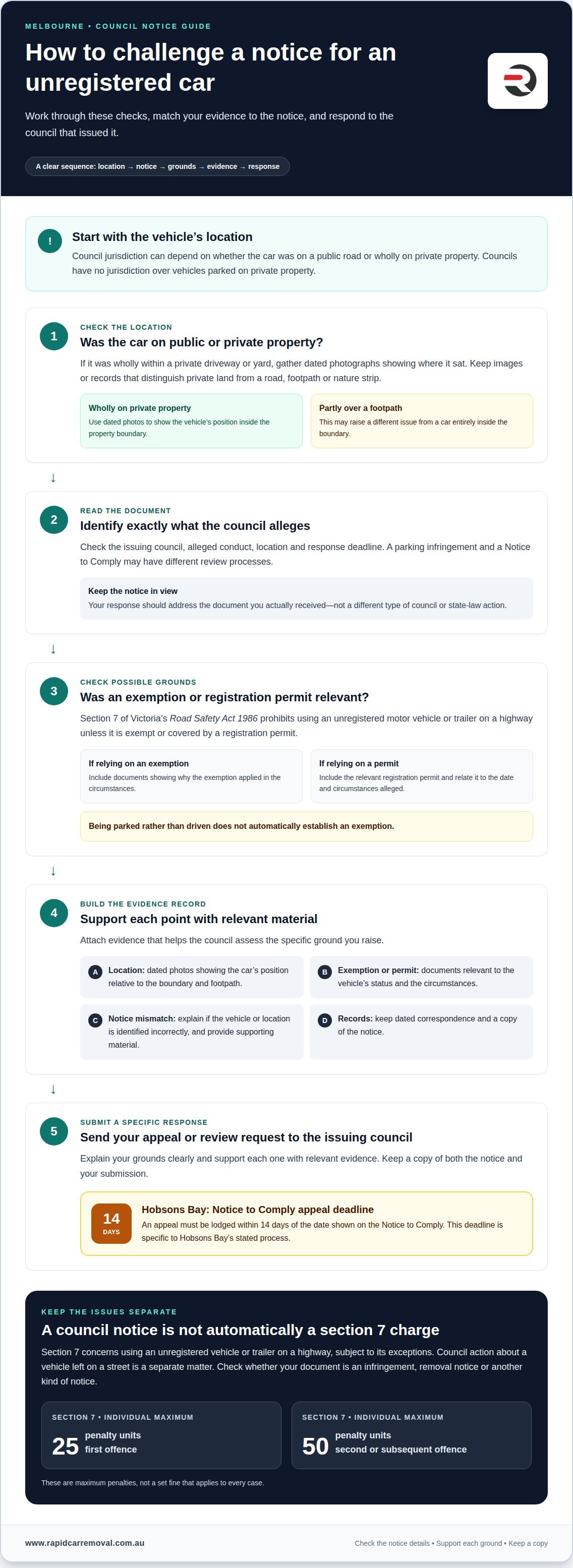
To challenge a council notice, send an appeal or review request to the council that issued it, and explain your grounds with supporting evidence. In Hobsons Bay, an appeal against a Notice to Comply must be lodged within 14 days of the date shown on the notice.
- Identify whether the vehicle was on public or private property. Councils have no jurisdiction over vehicles parked on private property. If the car was wholly within a private driveway or yard, gather dated photographs showing its position when the notice was issued. Keep evidence that distinguishes private land from a road, footpath or nature strip. A vehicle partly across a footpath may raise a different issue from one entirely inside a property boundary.
- Check whether an exemption or registration permit applied. Section 7 of Victoria’s Road Safety Act 1986 prohibits using an unregistered motor vehicle or trailer on a highway unless it is exempt or covered by a registration permit. If you rely on either exception, include the relevant permit or documents showing why the exemption applied. Explain the vehicle’s status and circumstances clearly. Don’t assume that being parked, rather than driven, automatically establishes an exemption.
- Match your appeal to the exact notice. Read the issuing council, alleged conduct, location and response deadline printed on the document. A council parking infringement and a Notice to Comply may involve different review processes. In Hobsons Bay, a person aggrieved by a Notice to Comply must appeal within 14 days of its stated date. Submit the request promptly and retain a copy of the notice and your submission.
- Build a clear evidence record. Attach photographs, dated correspondence, permit documents or other records that support your account. For example, if you say the vehicle was on private property, use images that show its position relative to the boundary and footpath. If the notice identifies the wrong vehicle or location, explain the mismatch and provide material that helps the council assess that specific point.
- Separate council action from a driving allegation. A fine about a vehicle left on a street is not automatically the same allegation as driving an unregistered vehicle. Section 7 concerns using an unregistered vehicle or trailer on a highway, subject to its stated exceptions. Set out whether your appeal disputes the location, the vehicle’s status, an applicable exemption or the notice’s details. Keep each ground specific and supported.
What Victorian laws apply to unregistered vehicles parked on public roads?
Use these steps to separate the state offence from council action. The rules involve Victoria’s Road Safety Act 1986 and, in some areas, local council powers.
- Read section 7 of the Road Safety Act 1986. It prohibits using an unregistered motor vehicle or trailer on a highway, unless it is exempt or covered by a registration permit. The law concerns use, so distinguish an allegation about driving from a council notice about a vehicle left on a street. Check the wording on the notice before deciding which issue it raises.
- Identify the alleged conduct and who received the notice. For an individual contravening section 7, the maximum penalty is 25 penalty units for a first offence. The maximum is 50 penalty units for a second or subsequent offence. These are maximum penalties, not a set fine that applies to every case. A council notice about an impounded vehicle is a separate matter to assess.
- Check whether the vehicle was exempt or covered by a permit. Section 7 provides exceptions for an exempt vehicle or one covered by a registration permit. If the notice concerns an alleged use of the vehicle, organise the relevant permit or exemption evidence around the date and circumstances alleged. A vehicle being parked does not, by itself, establish that an exemption applied.
- Separate state law from council enforcement. Councils may have powers to deal with unregistered vehicles on roads under legislation and local rules. Hobsons Bay City Council exercises powers over unregistered and abandoned vehicles under the Road Safety Act 1986. That council action does not make every council notice a section 7 charge. Check whether the document is an infringement, a removal notice or another kind of notice.
- Respond to the document you actually received. Note the issuing authority, the alleged conduct, the location and any stated deadline. Keep photographs and records that relate directly to those details. For example, evidence about where a vehicle was parked may matter to a council action, while permit documents may be relevant to a section 7 allegation. Don’t treat the two issues as interchangeable.
Once you’ve dealt with the legal notice, and the vehicle needs to leave the street, discuss the next step.
How long can an unregistered vehicle remain parked on a public street in Victoria?
There is no single statewide waiting period that makes it safe to leave an unregistered vehicle on a Melbourne street. The council’s powers and the vehicle’s circumstances matter, so act on any notice rather than relying on a set number of days.
- Find out which council controls the street. Port Phillip Council can remove unregistered vehicles from local streets and council car parks. That means a vehicle may face council action without a general street-parking period applying across Melbourne. Identify the local government area from the street address, then use the council named on any notice to understand the action being taken.
- Don’t treat two months as a waiting allowance. Hobsons Bay may consider a registered vehicle abandoned if it hasn’t moved for more than two months. In Broadmeadows, a legally parked registered vehicle left untouched for two months may also be treated as abandoned. Those examples concern registered vehicles. They don’t establish a two-month grace period for an unregistered car.
- Act as soon as you receive a council notice. Read the notice for its response date, required action and contact details. A notice may require action before any period associated with an abandoned vehicle becomes relevant. Keep a copy and record when it arrived. If the vehicle is unregistered and remains on the street, waiting for a two-month threshold could leave you dealing with a separate council action.
- Distinguish parking time from impound deadlines. Hobsons Bay states that an impounded vehicle not collected within 14 days may be sold, destroyed or given away by Council. That 14-day period applies after impoundment. It does not mean an unregistered vehicle can stay parked on a public street for 14 days before council action.
- Make a plan to move the vehicle off public land. If you can’t lawfully drive it, don’t use the street as long-term storage while deciding what to do. The next step depends on whether the car is on a public road, in a council car park or on private property, and whether the council has issued a notice. Keep the vehicle’s location and any correspondence together so you can respond to the relevant council promptly.
Do Melbourne council rules differ by local government area for unregistered cars?
Yes. Melbourne councils have different local laws, reporting channels and enforcement processes. Identify which council is responsible for the street before responding to a notice or reporting a vehicle.
- Match the street address to its council. Start with the exact location where the car is parked, not your home address. A vehicle on a Port Phillip street falls under different local provisions from one in Hobsons Bay or Hume. The notice should identify the issuing council. Use that council’s name to understand which local rules and processes apply to the vehicle.
- Check Port Phillip’s impoundment powers. Under the Local Government Act 1989, Schedule 11, clause 3, Port Phillip Council is authorised to impound unregistered vehicles parked on a road. The council can remove such vehicles from local streets or council car parks. If the car is in Port Phillip, read any impound notice carefully and follow the directions it gives.
- Look at both provisions applying in Hobsons Bay. Hobsons Bay City Council exercises powers over unregistered and abandoned vehicles under the Local Government Act 1989, Schedule 11, Clause 3. It also uses Clause 6.3 of the Hobsons Bay Community Local Law 2025. If you receive a Hobsons Bay notice, identify which action or provision it refers to before deciding how to respond.
- Check Hume’s rule for properties with several vehicles. Hume City Council may issue a Notice to Comply when a property has more than three unregistered vehicles. Hume treats a vehicle as unregistered if its registration has expired, it is unroadworthy, or it has no plates. Consider the vehicle’s condition and location when reading a notice. A car without plates may fall within Hume’s definition.
- Use the local reporting and response process. Port Phillip accepts reports through Snap Send Solve, My Port Phillip or by phoning ASSIST. Hobsons Bay residents can report an abandoned or unregistered vehicle by calling 1300 179 944. These are reporting options, not a substitute for responding to a notice addressed to you. Keep the council, location and notice details together so your next step fits that municipality.
Licensed wreckers and cash-for-cars buyers can purchase unregistered vehicles without a roadworthy certificate. This may be an option after you have checked the relevant council process.
Can an unregistered car be parked on the street?
Don’t assume a stationary car can stay on a public street indefinitely. Victoria’s Road Safety Act 1986 addresses using an unregistered vehicle on a highway, while councils can also act against vehicles left on public land. A council fine for an unregistered car parked on a Melbourne street may relate to local rules, not simply whether someone drove it.
- Separate parking from driving. Section 7 of the Road Safety Act 1986 prohibits using an unregistered motor vehicle or trailer on a highway, unless it is exempt or covered by a registration permit. A vehicle left parked raises a different practical issue from one being driven. Don’t drive it on a public road to move it elsewhere. Whether an exception applies depends on the vehicle’s status and circumstances.
- Identify the land beneath the vehicle. A street, council car park, footpath and nature strip are not the same as private property. Port Phillip Council can remove unregistered vehicles parked on local streets or in council car parks. In Broadmeadows, parking on a footpath or nature strip is illegal. A car protruding from a driveway onto the footpath can also attract an infringement.
- Move the vehicle off public land if you can do so lawfully. Use private property only if the vehicle fits entirely within it and does not obstruct a footpath. The owner remains responsible for resolving an unregistered vehicle on private property. If the car cannot be driven, don’t take it onto a road under its own power. Arrange a lawful way to remove or relocate it.
- Check how the local council describes the vehicle. Hume City Council treats a vehicle as unregistered if its registration has expired, it is unroadworthy, or it has no plates. For example, a damaged car without plates may still attract council attention while parked. Don’t assume an inoperative vehicle falls outside local rules because it can’t be driven. A council fine for parking an unregistered car on a Melbourne street can depend on the vehicle’s location and condition.
- Respond to any council action promptly. Port Phillip’s removal powers mean an unregistered car left in a council car park or on a local street may be removed. Keep the notice, its location details and any photographs together. If council has impounded the vehicle, follow the collection instructions. In Port Phillip, reclaiming an impounded vehicle includes presenting vehicle keys and photo ID.
Not driving a car does not make every public parking spot suitable for storing it. The location, condition and council rules all matter. Keep the vehicle off the road unless its legal status allows it to be used, and respond promptly to council directions.
Rapid Car Removal: cash for cars melbourne
Rapid Car Removal offers Cash for Cars and free removal for unregistered vehicles you no longer want to keep. If the car cannot be driven legally or has become difficult to store, selling it can provide a straightforward way to have it removed from your property or a street.
Share the vehicle’s make, model, condition and location to get started. This helps Rapid Car Removal discuss collection, and you do not need to drive the car to a buyer. Keep any council notice separate and follow its instructions: selling the vehicle does not resolve an existing fine or impound matter.
Ready to move on from the car? Contact Rapid Car Removal to discuss selling it and arranging free removal.
Choose your next step and clear the way forward
Keep council paperwork separate from your decision about the vehicle. If you receive a council fine for an unregistered car parked on a Melbourne street, keep the notice and any appeal correspondence together. Then consider whether keeping the car still makes practical sense. A vehicle that is difficult to move, store or repair can become an ongoing problem if you put off deciding what to do.
Before arranging a sale, note the car’s location and condition, and whether it can be driven. This gives you a clear starting point for discussing collection. Keep council matters separate: selling the vehicle does not resolve an existing notice or impound issue, so follow the instructions in any council correspondence.
If you’re ready to move on from the car, contact Rapid Car Removal about your vehicle. Taking one practical step can help you leave the car problem behind and focus on what comes next.
Frequently Asked Questions
Can the Council remove an unregistered car from my property?
Generally, a council has no jurisdiction over a vehicle parked on private property. A car fully inside your driveway is different from one partly over a footpath or left on a nature strip. If a council notice refers to a vehicle at your address, check the location it identifies and the action it requests. The owner remains responsible for resolving issues with an unregistered vehicle kept on private property.
Unregistered Car Parked on Broadmeadows Street: What Should You Do?
If your unregistered car is on a public road in Broadmeadows, report it to Hume City Council or respond to any notice you receive. Hume treats a vehicle as unregistered if its registration has expired, it is unroadworthy or it has no plates. Do not leave it on a footpath or nature strip, and make sure it does not extend from a driveway across the footpath.
Can Melbourne councils fine a car parked on a public street with expired or cancelled registration?
Under Hume City Council’s approach, a vehicle with expired registration can be treated as unregistered. Council action depends on the local area and the basis stated in the notice. If registration has been cancelled, read the notice carefully to understand what conduct or vehicle status it alleges. A fine concerning a parked vehicle is distinct from a charge alleging that someone used an unregistered vehicle on a highway.
How much is the fine for parking an unregistered car on a Melbourne street?
There isn’t one amount that applies to every council notice. The issuing council, alleged offence and notice determine the amount to address. Don’t confuse a parking infringement with a section 7 charge for using an unregistered vehicle: the maximum penalty for an individual is 25 penalty units for a first offence, or 50 penalty units for a subsequent offence. Check the notice to identify which matter applies.
Can a council tow or impound an unregistered car parked on a Melbourne street?
Yes, a council can impound an unregistered vehicle in areas where it has that power. For example, Port Phillip Council can remove unregistered vehicles from local streets and council car parks. If your vehicle is impounded there, the listed items for reclaiming it include the vehicle keys and photo ID. Follow the instructions from the council handling the impound, since processes differ between municipalities.
What should I do if my car registration has expired while it is parked on the street in Melbourne?
Don’t drive the car on a public road just to move it. Check whether the council has issued a notice, then arrange a lawful way to remove the vehicle from the street or place it on private property. If you’re considering driving it, section 7 of Victoria’s Road Safety Act 1986 provides an exception for a vehicle covered by a registration permit. Keep any relevant permit details with your records.


