

Missing registration papers don’t necessarily stop you arranging a scrap-car sale. If yours are lost, contact VicRoads for a replacement; a wrecker may also require proof of your identity, ownership or authority to act. If ownership is being transferred before scrapping, the buyer and seller must complete the vehicle transfer process within 14 days. Knowing how to transfer ownership of a scrap car in Vic starts with getting the paperwork in order before collection.
It’s understandable to want a clear answer before handing over a scrap car, especially if its registration documents are missing or it isn’t in your name. In Victoria, the right paperwork depends on your circumstances. You’ll need to show who owns the vehicle and who is authorised to sell it.
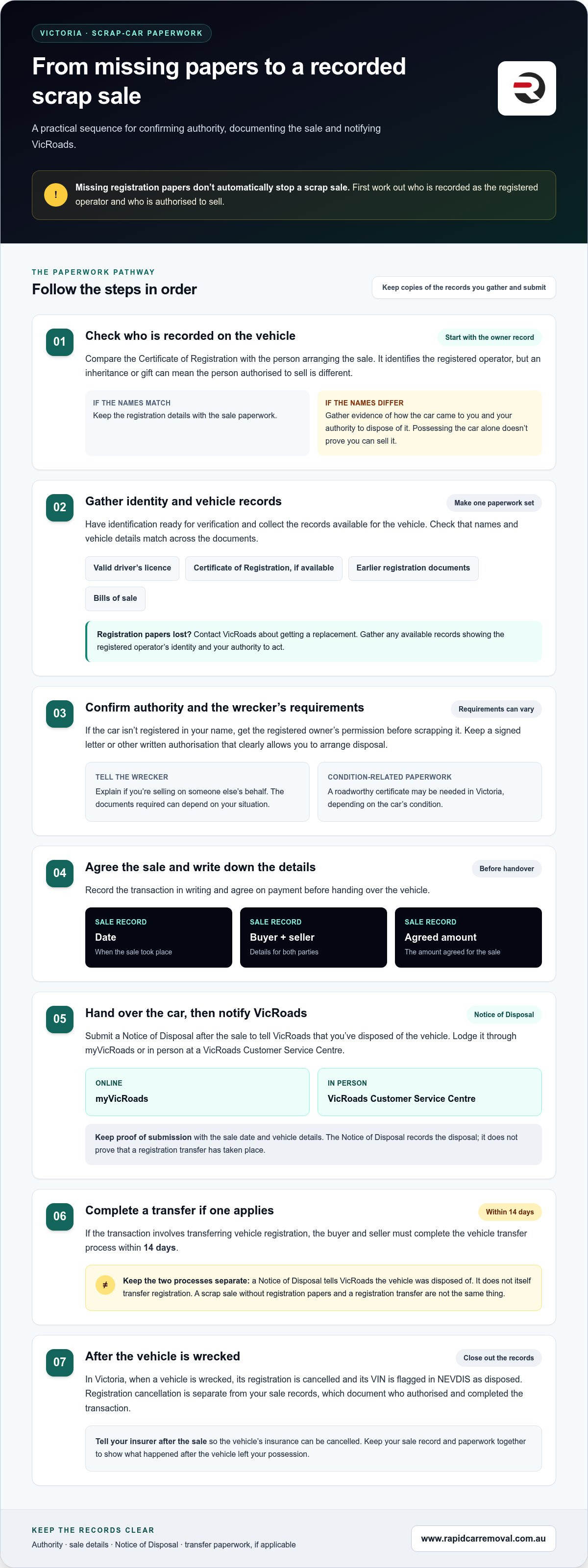
This guide explains what to do when papers are missing, what a wrecker may need, and how to handle the ownership transfer and Notice of Disposal before scrapping a car. It also covers why recording the sale and checking the vehicle’s registration status matter, so you can follow the right steps with confidence.
Key Takeaways
- Lost registration papers don’t automatically prevent a scrap-car sale; contact VicRoads about getting a replacement.
- Have identification ready and gather evidence of ownership or permission to sell, especially if the car isn’t registered in your name.
- Complete the ownership transfer within 14 days and submit the Notice of Disposal through myVicRoads or at a VicRoads Customer Service Centre.
- Record the sale details in writing and agree on payment before handing over the vehicle.
- Tell the wrecker if you’re selling on someone else’s behalf, as the documents they need can depend on your situation.
Certificate of Registration as proof of ownership
Start by identifying the person recorded on the vehicle’s Certificate of Registration before arranging a scrap sale. In Victoria, this document shows who the registered owner is, but that record may not tell the whole story if the vehicle was inherited or given to someone else.
-
Confirm the Registered Owner
Check the Certificate of Registration and compare its details with the person arranging the sale. The registered operator is the person recorded for the vehicle, but the person authorised to sell it may differ after an inheritance or gift. Possessing the car alone doesn’t prove you can sell it. If the names differ, gather records showing how the vehicle came to you and your authority to dispose of it.
-
Gather Registration Documents and Bills of Sale
Gather the Certificate of Registration, any earlier registration documents and bills of sale relating to the vehicle. A bill of sale can help show its ownership history and who bought it. Keep the paperwork together and check that the names and vehicle details match. If you’re asking about cancellation or transfer costs, the amount depends on the VicRoads transaction and the vehicle’s registration status.
-
Get the Registered Owner’s Authorisation
Get the registered owner’s permission before scrapping a vehicle that isn’t registered in your name. Keep a signed letter or other written authorisation that clearly allows you to arrange the disposal, together with the registration papers and bills of sale. For example, if you’re handling a deceased relative’s car, keep records showing your authority to act.
-
Account for Registration Cancellation When the Car Is Wrecked
Ask for the disposal to be recorded correctly when the vehicle is wrecked. In Victoria, its registration is cancelled and its VIN is flagged in NEVDIS as disposed. These are separate from the sale records: cancellation relates to registration, while your documents record who authorised and completed the transaction.
Keep a written sale record with the date, buyer’s and seller’s details, and agreed amount. Tell your insurer after the sale to cancel the vehicle’s insurance. If the Certificate of Registration is missing, gather the available records showing the registered operator’s identity and your authority to act. Clear documentation helps explain what happened to the vehicle after it left your possession.
Can I sell a car to a wrecker without the registration papers?
Missing registration papers don’t automatically prevent a scrap sale. Separate the disposal notification from any registration transfer, then complete the paperwork that applies to the vehicle.
-
Prepare the VicRoads Disposal Paperwork
Identify the paperwork you need before handing over the vehicle. To notify VicRoads that it has been sold or scrapped, submit a Notice of Disposal. If the sale also requires a registration transfer, the buyer and seller must complete the vehicle transfer process. Keep the sale details and vehicle identifier together. A disposal notice does not prove that a registration transfer has taken place.
-
Submit the Notice of Disposal
Record the sale and notify VicRoads after handing over the vehicle. The Notice of Disposal tells VicRoads that you’ve disposed of it. Submit the notice through myVicRoads or in person at a VicRoads Customer Service Centre. Keep proof of submission with the sale date, so you can show when you notified VicRoads if questions arise.
-
Notify VicRoads Online
Use myVicRoads to lodge the Notice of Disposal online, or visit a VicRoads Customer Service Centre if you’re submitting it in person. Submit the required disposal paperwork promptly after the sale. This answers the timing question: the seller should notify VicRoads within that period. Don’t confuse it with the separate 14-day period for the buyer and seller to complete a vehicle transfer.
-
Handle the Registration Transfer
Work out whether the transaction involves transferring registration or simply disposing of a vehicle for scrap. The buyer and seller must complete the vehicle transfer process within 14 days when a transfer applies. A car can be sold for scrap without its registration papers, but a Notice of Disposal records the disposal; it does not itself transfer registration. When a car is wrecked in Victoria, its registration is cancelled.
For a missing-paper sale, gather the vehicle details and sale record, then lodge the Notice of Disposal. If the car isn’t in your name, arrange the registered owner’s authority before disposal. If it is unregistered or written off, distinguish the scrap sale from a transfer of active registration, and complete the disposal notification for the sale. Keep copies of the paperwork and note the date the vehicle left your possession. For help with the practical next step, get in touch about vehicle disposal.
Documents needed to sell a car to a wrecker
A roadworthy certificate may be needed in Victoria, depending on the car’s condition. Before selling, gather identification, vehicle records and paperwork showing that you own the car or are authorised to dispose of it.
- Prepare your identity documents. Have a valid driver’s licence ready for identity verification when selling a car to a wrecker in Victoria. Check that the name on your licence matches the seller details you provide. If someone else is handling the sale, explain their role and bring the registered owner’s written permission.
- Gather the vehicle’s registration records. Bring the Certificate of Registration, if available, and any other documents that help identify the vehicle and its registered operator. Compare the registration details with the vehicle before collection. If the papers are lost, gather the ownership records you do have and resolve the missing-document issue before signing or handing over the car.
- Gather proof of ownership or authority to sell. A bill of sale can show how the vehicle changed hands and who bought it. For a gifted or inherited vehicle, a statutory declaration may be required to prove ownership. Keep supporting documents together, showing your connection to the car rather than relying on possession of its keys alone.
- Record the vehicle’s identifying details. Write down its registration number, make, model and VIN where available. For a vehicle manufactured from 1 January 1989, Victoria defines its vehicle identifier as the permanently recorded VIN. Match that identifier against the vehicle and your paperwork so the sale record refers to the correct car.
- Prepare a written sale record with the sale date, agreed amount, vehicle details and both parties’ details. Check the information before signing and keep a copy after the transaction. A bill of sale documents what was sold and when. The Notice of Disposal serves a separate purpose: notifying VicRoads that the vehicle has been disposed of.
- Gather any paperwork relating to the vehicle’s condition. Be upfront about damage, missing parts or other issues, and describe the condition accurately in the written agreement. A roadworthy certificate may depend on the car’s condition, so don’t assume it’s required for every scrap sale. Keep any existing inspection or repair records with the other documents.
Before handover, check that your identity documents, proof of ownership and sale record are ready. Keep copies of the signed paperwork and update your records after the vehicle leaves your possession.
Checking a scrap yard's requirements
Before handing over registration papers, clarify what the transaction requires and how payment will be made. In Victoria, scrap-metal rules apply to motor vehicles sold or obtained as scrap, whether they’re working or not.
- Tell the wrecker who owns the vehicle. If you’re acting for someone else, explain this before arranging collection and have the registered owner’s signed authorisation ready. Registration papers and bills of sale can show the vehicle’s history, but you’ll also need evidence that you’re entitled to dispose of it. Keep copies of the documents you provide.
- Ask what identification and vehicle details are needed. Licensed scrap-metal dealers must verify and record the seller’s identity, and records for motor vehicle transactions must include a vehicle identifier. Have your identification and the VIN or other vehicle details ready. Check the VIN against the vehicle to make sure the records relate to the right car.
- Confirm the payment method before agreeing to the sale. In Victoria, buying or selling scrap metal for cash is an offence carrying a penalty of 200 penalty units. Scrap-metal dealers must use traceable payment methods, such as an electronic funds transfer or crossed cheque. Don’t hand over the car expecting cash in person; agree on a permitted method and record it in writing.
- Ask how the yard records and retains the transaction. Victoria’s second-hand goods rules generally require goods to be retained for 7 days, subject to exemptions. A second-hand dealer may be exempt for a motor vehicle more than 15 years old if it’s acquired only for demolition or dismantling. For a vehicle 15 years old or less, the stated exemption applies when it’s listed as a statutory write-off.
- Before the sale, run a current finance and stolen-status check using the vehicle’s VIN and registration details. Compare the results with the vehicle identifiers and paperwork. Registration papers identify the registered operator, but don’t establish whether finance is owing or the vehicle is recorded as stolen. Resolve any mismatch before signing a sale agreement or accepting payment.
- Get the terms in writing before the vehicle leaves. Record the sale date, vehicle identifier, condition, payment method and both parties’ details. Tell the wrecker if the car isn’t registered in your name, and include the owner’s signed authority. This makes your role clear and records what was agreed.
Transferring ownership before scrapping
Putting the vehicle into your name before scrapping can simplify the sale and reduce legal complications. Treat the ownership transfer, payment and VicRoads disposal notification as separate steps.
- Confirm who is authorised to sell the vehicle. If you’re the registered operator, gather the registration details and sale records. If the car was inherited or belongs to someone else, get the registered owner’s written authorisation before arranging a transfer. Having the keys or a Certificate of Registration doesn’t necessarily make you the legal owner.
- Decide whether transferring ownership into your name is appropriate. It may make the paperwork clearer if you inherited the vehicle or have permission to scrap it. Keep evidence of the inheritance or authorisation with the vehicle records. If ownership is already clear and the seller can complete the disposal paperwork, focus on recording the sale and notifying VicRoads.
- Complete the transfer form with the buyer and seller. Both parties must sign the Transfer of Ownership form when a car is sold to a wrecker. The form is provided and completed on pickup, so check its vehicle details and party information before signing. Keep a copy or written record of the completed transaction for your own files.
- Agree on payment before signing away control of the vehicle. Don’t transfer ownership before receiving payment. Record the agreed amount and payment method in writing, then confirm the payment has arrived before completing the handover. This keeps a clear record and avoids a gap between signed paperwork and payment.
- Notify VicRoads after the sale and keep the disposal record. Submit the Notice of Disposal within 15 days after selling the car, separately from the ownership transfer. The buyer and seller must complete the vehicle transfer process within 14 days. These are distinct actions: completing one doesn’t replace the other.
- Keep the final paperwork with your insurance records. When a car is wrecked in Victoria, its registration is cancelled and its VIN is flagged in NEVDIS as disposed. Store the signed transfer form, payment record and disposal confirmation together. These documents provide a timeline if questions arise about the vehicle’s later status or your responsibility.
Need to arrange the sale and paperwork for an unwanted vehicle? Contact Rapid Car Removal about your vehicle.
Rapid Car Removal: Cash for Cars
Rapid Car Removal offers Cash for Cars when you’re ready to dispose of an unwanted vehicle after sorting the paperwork. Its Free Car Removal service can help with the practical step of getting the car collected, while Scrap Truck Removal and Cash for 4x4s cover other unwanted vehicles.
Have the vehicle details, ownership records and any written authorisation ready when arranging the sale. Keep the signed sale documents and submit the required Notice of Disposal to VicRoads after handover. This keeps collection and paperwork as separate, clear steps.
For a scrap car, truck or 4x4 that’s ready to go, contact Rapid Car Removal to discuss the next step.
Set up a clear handover
Before arranging collection, gather your sale records and keep them together. A digital or printed folder gives you one place for the paperwork and a record of when the vehicle leaves your possession. If someone else is involved, make sure they understand what they’re authorising and have a copy of the agreed sale details.
Knowing how to transfer ownership of a scrap car in Victoria means connecting the handover with the follow-up paperwork. Choose your next step based on the vehicle’s circumstances rather than assuming every scrap sale follows the same process. Keeping clear records now can help answer later questions about the transaction.
When you’re ready to discuss removing your vehicle, contact Rapid Car Removal. Share the details you have and take the next step at your own pace. With the paperwork gathered and the handover planned, you can move forward with a clearer process.
Frequently Asked Questions
What happens if you don’t notify VicRoads?
If you don’t notify VicRoads, the vehicle may remain associated with you in its records, leaving you exposed to later questions about its use or disposal. A registered operator can be legally responsible for vehicle penalties or fines even when they weren’t driving. Keep evidence of the sale and lodge the Notice of Disposal promptly. Retain the submission confirmation with your sale record and collection date.
Do I need to do anything with VicRoads when I dispose of my car?
Yes. Submit a Notice of Disposal to VicRoads after selling or scrapping the vehicle. You can lodge it through myVicRoads or in person at a VicRoads Customer Service Centre. Keep a record of the submission, vehicle details and handover date. When disposing of a wrecked car, check what steps apply to its registration and disposal notification.
How do I transfer ownership when selling your junk car?
For how to transfer ownership of a scrap car in Victoria, make sure the buyer and seller complete and sign the Transfer of Ownership form. The transfer process must be completed within 14 days. Check the vehicle and party details before signing, and keep a copy of the completed paperwork. Agree on the sale terms in writing, and don’t transfer ownership before receiving payment.
How do I dispose of a car in Victoria?
Arrange the sale or scrap handover with a buyer, document the transaction, and notify VicRoads that the vehicle has been disposed of. Don’t leave the car on a public road or someone else’s property, as abandoning a vehicle there is illegal in Victoria. If you’re handling a relative’s car, secure their authorisation or relevant inheritance records before arranging collection.
How do I transfer or cancel registration for a scrap car in Victoria?
For a sale that involves a registration transfer, the buyer and seller complete the transfer process within 14 days. If the car is wrecked, its registration is cancelled in Victoria. These are different outcomes: a transfer records a change between parties, while cancellation follows the vehicle being wrecked. Keep the paperwork that shows what happened, rather than treating a disposal notice as a transfer form.
What should the seller and scrap-yard buyer do to complete a vehicle transfer in Victoria?
The seller and buyer should complete and sign the Transfer of Ownership form, check the vehicle details, and keep a written record of the transaction. Both parties must complete the transfer process within 14 days. The seller should also lodge the Notice of Disposal with VicRoads. The buyer’s transfer and the seller’s disposal notification are separate actions, so don’t assume one completes the other.
What risks should I avoid when selling a scrap car privately or to a wrecking yard in Victoria?
Don’t hand over a vehicle without a written record of the buyer, sale date, vehicle details and agreed payment method. Don’t accept cash for scrap metal, as buying or selling scrap metal for cash is an offence in Victoria. If you’re selling for someone else, get their permission first. Keep your sale documents and notify VicRoads so you can show when the vehicle left your possession.


