

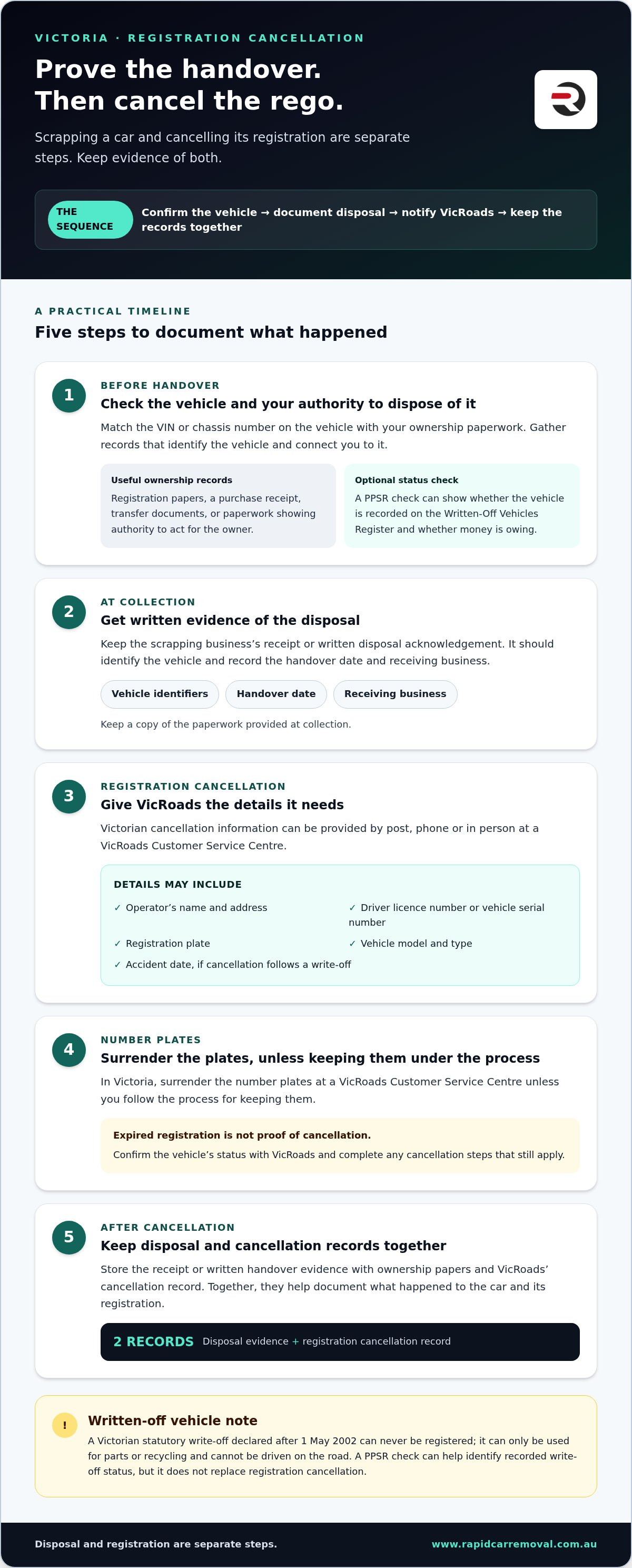
Scrapping a car and cancelling its registration are separate steps. To understand how to prove a car has been scrapped in Victoria, keep the disposal paperwork as evidence, then provide VicRoads with the details needed to cancel the registration. These may include your name and address, licence or vehicle serial number, registration plate, vehicle model and type, and the accident date if the car was written off. Unless you follow the process for keeping them, surrender the number plates at a VicRoads Customer Service Centre.
It’s easy to assume the paperwork is finished once the car is collected, but registration cancellation needs separate attention. This guide explains the Victorian cancellation process, the ownership and identity evidence you may need when scrapping a vehicle, and how the steps differ across Australian states. You’ll also learn what records to keep, so you can document both the vehicle’s disposal and its registration status.
Key Takeaways
- Keep paperwork that records the vehicle’s disposal, and be ready to show you have the right to dispose of it.
- In Victoria, give VicRoads the vehicle and operator details needed to cancel registration, and surrender the number plates unless you follow the process to keep them.
- Cancellation steps differ between states and territories, so use the process that applies where the vehicle is registered.
- A statutory write-off cannot be driven on the road; its status affects what can happen to the vehicle next.
- Keep your cancellation records with the disposal documents so you can show what happened to the car and its registration.
Registration cancellation procedures across Australian states
Scrapping a vehicle and cancelling its registration are separate steps. The process depends on where the vehicle is registered, so follow that jurisdiction’s cancellation procedure and keep records of both the handover and the registration outcome.
- Check the vehicle’s status. A Personal Property Securities Register (PPSR) check can show whether it is recorded on the Written-Off Vehicles Register and whether money is owing on it.
- Cancel Victorian registration. Give VicRoads the operator’s name and address, driver licence number or vehicle serial number, registration plate, model and type. If cancellation follows a write-off, include the accident date.
- Deal with the number plates. In Victoria, surrender them at a VicRoads Customer Service Centre unless you follow the process for keeping them.
VicRoads accepts Victorian cancellation information by post, phone or in person at a Customer Service Centre. If registration has expired, don’t assume this proves the vehicle has been removed from the register. Confirm its status with VicRoads and complete any cancellation steps that still apply. Keep the disposal paperwork and cancellation record together.
When a Victorian vehicle is written off, its classification matters. A statutory write-off declared after 1 May 2002 can never be registered and can only be used for parts or recycling. It can no longer be driven on the road. A PPSR check can help identify recorded write-off status, but it does not replace the registration cancellation process.
Other jurisdictions have different steps:
- Northern Territory: lodge a Notice of Disposal with the Motor Vehicle Registry within 14 days of disposal or sale. Include buyer and seller details, disposal date, sale price, signatures and registration number, then surrender the plates to Motor Vehicle Registration.
- Queensland: submit a completed vehicle or recreational ship cancellation application and plates at a transport and motoring customer service centre. The application and plates or receipt can also be posted.
- South Australia: complete an application to cancel registration, surrender the plates and lodge the application at a Service SA customer service centre.
- Tasmania: return the plates to Motor Vehicle Registration. For a transfer or disposal, take the Application for Transfer / Notice of Disposal to a Service Tasmania shop within 7 days.
- ACT: for vehicles over 4,500 kg, provide a statement about the registration label when cancelling registration.
Can I get a refund for unused registration in Victoria? Cancelling registration and receiving a refund are separate matters. Keep the cancellation record and check with VicRoads whether your circumstances qualify for a refund.
Do I need a certificate of destruction for a scrapped car in Victoria? Keep the scrapping business’s receipt or written disposal acknowledgement as evidence of the handover, and retain VicRoads’ record as evidence of registration cancellation.
How long should I keep scrapping and cancellation records? Keep them securely for as long as you may need to resolve questions about ownership, disposal or registration. Store the receipt, written handover evidence and cancellation record together.
How do I check whether a vehicle is still registered in Victoria? Ask VicRoads to check the vehicle’s status using its registration number and identifying details. Compare the result with your cancellation record before treating the registration as cancelled.
Vehicle ownership and proof of identity when scrapping
Before handing over a vehicle, make sure you have the right to dispose of it. A scrapping business cannot trade an unidentified vehicle, so its identity and your authority to hand it over need to be clear. Match the vehicle identification number (VIN) or chassis number on the vehicle against your ownership paperwork.
Gather documents that identify the vehicle and connect you to it. Depending on your circumstances, useful records may include registration papers, a purchase receipt, transfer documents or paperwork showing your authority to act for the owner. Keep a copy of the paperwork provided at collection. Clear records link the vehicle, the person handing it over and the business receiving it.
- Check the vehicle identifiers. Compare the VIN or chassis number with your ownership documents before collection.
- Record who is handing it over. Make sure the disposal paperwork names the person or legal owner authorising the handover.
- Keep a dated receipt. Ask for a written acknowledgement identifying the vehicle and recording that it was collected for scrapping or recycling.
- Keep copies together. Store the handover record with ownership papers and VicRoads registration cancellation records.
What paperwork should a licensed vehicle recycler provide in Victoria? Keep a written receipt or disposal acknowledgement showing the vehicle’s identifiers, handover date and receiving business. This gives you a practical record of the transaction alongside your ownership documents.
How can I prove a car was scrapped if I no longer have the registration plates? Identify the vehicle using its VIN or chassis number, then match it with your ownership papers and disposal receipt. Keep any VicRoads cancellation record as separate evidence of the registration outcome.
Written-off vehicles need extra care if someone plans to repair and register them. A Victorian vehicle may be added to the Written-Off Vehicles Register after purchase because recording can be delayed. If that happens, a Vehicle Identity Validation (VIV) certificate may be required to keep it on the road.
For a repaired written-off vehicle, keep evidence of the work and replacement parts. Receipts for replacement parts need to include the VIN of the vehicle those parts came from. In Victoria, a statutory declaration cannot replace a missing repair or parts receipt. Before registration, the repaired vehicle needs a Victorian VIV certificate and a roadworthy, followed by a VicRoads registration appointment.
A VIV certificate does not guarantee that a repaired vehicle will have no future problems. It supports the identity validation process. Keep repair invoices, parts receipts and inspection records so the vehicle’s history is traceable. If the vehicle is being scrapped instead, retain the handover evidence rather than treating repair paperwork as proof of disposal.
If a truck is being scrapped and you need to arrange its removal, use the vehicle removal contact page to discuss the handover.
What documents prove a car has been scrapped in Victoria, Australia?
The clearest evidence is a written record linking the vehicle, its owner and its disposal. Ask for a receipt or disposal acknowledgement that identifies the car by its VIN or chassis number, records the handover date and names the receiving business. Keep the original and a digital copy. These details help distinguish your vehicle from another car of a similar make or model.
To show how to prove a car has been scrapped in Victoria, bring together the handover record and documents connecting you to the vehicle. Registration papers, purchase records or transfer documents can help establish your ownership or authority to dispose of it. Compare the VIN on the vehicle with the number on your documents before collection. If another person arranges the handover, keep written evidence of their authority.
- Disposal receipt: check that it identifies the vehicle and records the handover date.
- Ownership evidence: keep registration, purchase or transfer documents that connect you to the car.
- Registration record: file any VicRoads cancellation correspondence separately from the disposal receipt.
- Supporting material: retain relevant messages, collection arrangements and photographs of the vehicle identifiers.
Each record serves a different purpose. A receipt documents the handover for scrapping or recycling. Ownership papers connect you to the vehicle, while VicRoads correspondence relates to registration. Together, they help explain the vehicle’s history if questions arise. Check that names, dates and identifiers match across the documents, and resolve any discrepancy while the handover details are fresh.
A Written-Off Vehicles Register entry does not establish that a car was scrapped. It records written-off status, which is not the same as proof of disposal. A Victorian WOVR extract is available only for vehicles registered in Victoria and recorded on the register there. To request an extract, call VicRoads on 13 11 71.
Use the extract to check recorded write-off history, then use the disposal acknowledgement to document what happened to the vehicle. A written-off car may be repaired rather than scrapped, so its register entry alone does not prove it was recycled. Keep repair invoices and parts receipts separately if repair work was carried out.
For a reliable file, store the documents together and label the folder with the VIN or registration number. Scan paper records while the writing is legible. If someone later asks how to prove a car has been scrapped in Victoria, you can retrieve the receipt, ownership evidence and VicRoads correspondence as one connected record.
How do I cancel rego after scrapping a car in Victoria?
Arrange the vehicle’s disposal, then handle its registration separately through VicRoads. Collection by a scrapping business does not itself complete registration cancellation. Keep the disposal receipt and follow the VicRoads steps so your records show both events.
- Gather the vehicle and operator details. VicRoads may need the operator’s name and address, driver licence number or vehicle serial number, registration number plate, model and type, and the accident date if cancellation follows a write-off.
- Choose how to provide the information. Send it by post, give it by phone, or provide it in person at a VicRoads Customer Service Centre.
- Deal with the number plates. Surrender them at a VicRoads Customer Service Centre unless you follow the process for keeping them.
- Keep evidence of disposal and cancellation. File the scrapping receipt with your registration records so the vehicle handover and VicRoads process are documented separately.
Check each detail before contacting VicRoads. Compare the registration number and vehicle model with your paperwork, and use the vehicle serial number if that is the identifier available to you. If the car was written off in an accident, have the accident date ready. Accurate details help VicRoads identify the correct vehicle and process the cancellation information.
Expired registration and cancelled registration are different matters. If the rego has expired, don’t treat expiry as proof that the vehicle was scrapped or that VicRoads has recorded a cancellation. Contact VicRoads with the registration number and vehicle details to establish its status, then provide the cancellation information for the vehicle.
Write-off status also affects what happens next. A statutory write-off declared in Victoria after 1 May 2002 can never be registered and can only be used for parts or recycling. It cannot be driven on the road. Include the accident date when giving VicRoads cancellation information because the cancellation follows the vehicle being written off.
If you’re arranging disposal of a statutory write-off, have a scrap service collect it rather than driving it. Keep the collection receipt and note the vehicle identifiers on your copy. Then complete the VicRoads cancellation steps using the relevant operator and vehicle details. The receipt supports proof of handover, but it does not replace the separate registration process.
After submitting the information, keep any correspondence or record you receive from VicRoads with your disposal paperwork. If you provided details by phone, note the date and information supplied. If you attended a Customer Service Centre, keep any paperwork provided there. These records help show what you did if questions later arise about the vehicle’s disposal or registration.
Does VicRoads issue a receipt or confirmation when a vehicle registration is cancelled?
Keep any VicRoads correspondence or transaction record you receive when arranging cancellation. A scrapping receipt and a registration record prove different things: the first records the vehicle handover, while VicRoads information relates to its registration. File them separately, then keep both with the vehicle’s VIN and registration details so the records can be matched.
VicRoads accepts cancellation information by post, phone or in person at a Customer Service Centre. Use the same vehicle identifiers in your records and communications. These may include the registration number, model and type, and vehicle serial number. If cancellation follows a write-off, note the accident date as well.
Make a simple record of how and when you provided the information. For a phone call, note the date and details discussed. For a posted request, keep a copy of the information and evidence of postage. If you attend a VicRoads Customer Service Centre, retain any paperwork provided. These personal records help establish what you submitted and when.
- Save VicRoads correspondence. Keep letters, emails or transaction records with the vehicle file.
- Keep the disposal receipt separately. It records handover for scrapping, not the registration outcome.
- Match the identifiers. Compare the VIN or vehicle serial number and registration number across documents.
- Record the cancellation contact. Note whether you used post, phone or a Customer Service Centre.
A PPSR check serves a different purpose. It can show whether a vehicle is on the Written-Off Vehicles Register and whether money is owing. It does not replace VicRoads registration information or a scrapping receipt. Likewise, a Victorian WOVR extract concerns written-off vehicle history and is available only for vehicles registered and recorded on the Victorian register.
To establish the vehicle’s current registration status, contact VicRoads with the registration number and vehicle details. Keep any information provided with your cancellation paperwork. If the car’s registration had expired, record that separately: expiry alone does not document the scrapping handover.
For a clear file, use a folder labelled with the vehicle’s registration number or VIN. Save a scan of the scrapping receipt, copies of your VicRoads correspondence and notes about the cancellation contact. This creates a practical timeline: vehicle identified, disposal recorded, cancellation information submitted, and any response filed.
If a truck still needs to be collected for scrapping, arrange truck removal and keep the handover paperwork with your VicRoads records.
Before arranging collection, make sure you have the right to dispose of the vehicle and provide proof of vehicle ownership. A vehicle owner should have a scrap car collected by a registered car scrapping business so it can be correctly disposed of and recycled.
If the vehicle was written off, keep related records separate from the registration cancellation paperwork. A vehicle declared a statutory write-off can no longer be driven on the roads. In Victoria, a written-off vehicle must pass a VIV inspection before it can be registered after repair.
Rapid Car Removal: Cash for Cars
Rapid Car Removal can collect unwanted vehicles for disposal across Melbourne. Free Car Removal is available for unwanted cars, and Scrap Truck Removal for trucks that need to be taken away. For a vehicle damaged in an accident, Accident Car Removal is another option.
Before collection, have your ownership and vehicle details ready, including the VIN if available. Keep the disposal paperwork you receive, then complete the separate VicRoads registration cancellation steps and retain any related records. Collection does not itself cancel registration.
If you’re ready to arrange vehicle collection in Melbourne, contact Rapid Car Removal for free car removal.
Move on with a clear next step
Once the vehicle’s disposal is behind you, you can move forward with a clear record. Knowing how to prove a car has been scrapped in Victoria can help you respond if questions about its history come up later. Keep your records accessible and rely on the documents rather than memory.
If collection is still to be arranged, prepare the information you’ll need. A clear description of the vehicle and its condition can make the conversation more straightforward. You can also explain whether it is a car or truck and where it is waiting.
For a practical next step, send Rapid Car Removal your vehicle details. Take the process one step at a time, and you can move on with greater confidence.
Frequently Asked Questions
What do I need to know about scrapping my car?
Confirm you have authority to dispose of the car and can match its identity to your paperwork. Before handover, compare the VIN on the vehicle with your ownership records and ask for a written receipt identifying the vehicle. If you’re arranging disposal for someone else, keep evidence of their authority. Treat scrapping and registration cancellation as separate tasks, and follow the cancellation process for the state where the car is registered.
What should I do if a car was scrapped but VicRoads still shows it as registered?
Contact VicRoads and explain that the vehicle was scrapped but still appears registered. Have its registration number, VIN or vehicle serial number, disposal receipt and any cancellation correspondence ready. Ask VicRoads to check the vehicle record and explain what information they need to update it. Note the contact date and outcome, and keep any new correspondence with the scrapping paperwork.


