

A damaged or written-off car doesn’t have to become a permanent driveway fixture. In Victoria, abandoning a vehicle on a public road, nature strip or someone else’s private property is illegal. If you need to get rid of a car in your driveway in Melbourne, understanding the rules and arranging removal are practical first steps.
It’s frustrating when an unwanted vehicle takes up space, especially if it’s accident-damaged or no longer roadworthy. This guide explains what the law says, how a car’s condition can affect what you’re offered, and what to expect from pickup, payment and service hours.
You’ll also find practical steps for the handover, including what to check on the receipt and how to deal with the registration and plates. Knowing what to expect makes it easier to choose a suitable way to clear the car from your property.
Key Takeaways
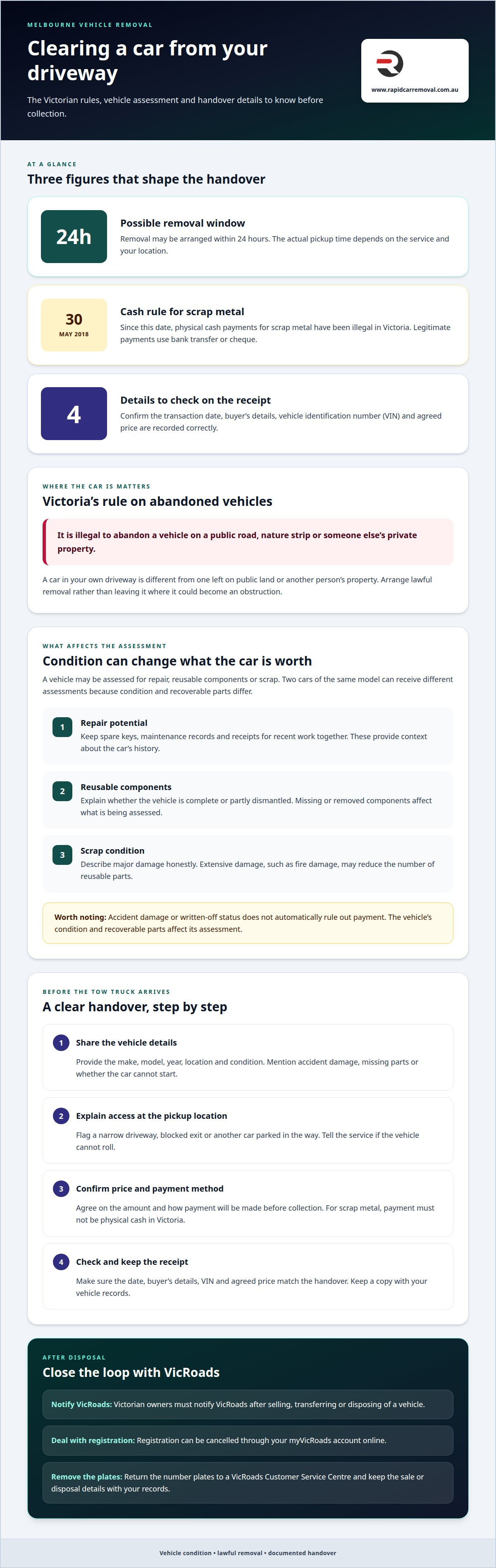
- In Victoria, don’t abandon a vehicle on a public road, nature strip or someone else’s private property. Sort out removal and the relevant vehicle paperwork instead.
- Accident damage or a written-off status doesn’t automatically rule out a payment; the vehicle’s condition and recoverable parts affect its assessment.
- Before towing, get a receipt recording the date, buyer’s details, vehicle identification number and agreed price.
- Since 30 May 2018, physical cash payments for scrap metal have been illegal in Victoria; legitimate payments use bank transfer or cheque.
- Removal may be arranged within 24 hours, but pickup timing depends on the service and your location.
Is It Legal to Abandon a Car in Victoria?
In Victoria, abandoning a vehicle on a public road, nature strip or someone else’s private property is illegal. A car left in one of these places can create a legal problem as well as an obstruction. Arrange lawful removal rather than leaving it where it sits.
The location matters. A car in your own driveway is different from one left on a nature strip or someone else’s land. If the vehicle is on a public road, nature strip or another person’s property, organise its removal promptly. Don’t assume a damaged, unregistered or unwanted car can simply remain there.
After selling, transferring or disposing of a vehicle, Victorian owners must notify VicRoads. Remove the number plates and return them to a VicRoads Customer Service Centre. You can cancel the registration through your myVicRoads account online. Keep the sale or disposal details with your registration records.
To cancel Victorian vehicle registration, use your myVicRoads account online. Remove the plates and return them to a VicRoads Customer Service Centre.
For a donation in Melbourne, contact a charity that accepts vehicles and arrange the handover or collection. A tax benefit isn’t automatic; it depends on the recipient and donation arrangement, so don’t assume a donation is deductible.
Before choosing a removal option, request a free quote and vehicle evaluation. Give accurate details about the make, model, year, location and condition. For example, mention if the car has accident damage, missing parts or cannot start. These details help the evaluator understand what is being assessed and provide a more useful quote. Ask how the evaluation works and what information is needed before collection.
Rapid Car Removal provides free towing across Melbourne, including from driveways. This is useful when a car won’t start or can’t be driven. When arranging collection, describe the pickup location and access: a narrow driveway, blocked exit or vehicle parked behind another car may affect how the tow truck can reach it.
- Identify whether the car is on your property, a public road or a nature strip.
- Describe its condition accurately when requesting a quote.
- Arrange removal before it becomes an obstruction on public or other private land.
- Complete the VicRoads notification and registration steps after disposal.
These steps separate a lawful disposal from simply leaving a vehicle behind. They also help you prepare the car, location details and paperwork before it is removed.
Payment for cars in different conditions
A vehicle’s condition can affect whether its value comes mainly from resale, reusable components or scrap material. A complete car that can be repaired may be assessed differently from one suited to dismantling. That helps explain why two cars of the same model can receive different assessments, even when both are unwanted.
Help the evaluation reflect the vehicle as it stands. Gather useful items such as spare keys, the owner’s manual and service records. Maintenance records can provide context about the car’s history. If you remove components before assessment, explain what has changed, since a partly dismantled vehicle differs from a complete one.
Consider the difference between visible wear and damage that affects how the vehicle could be used. Faded paint or a worn interior may leave major components intact, while extensive fire damage may reduce the number of reusable parts. Describe what you can see, then let the evaluation consider repair potential, parts recovery or scrap value.
If you’re working out how to get rid of a car in your driveway in Melbourne, gather relevant details before discussing an offer. Note whether you have spare keys, maintenance paperwork or receipts for recent work. These items provide context about the vehicle’s history and completeness.
- Repair potential: keep maintenance records and keys together.
- Reusable components: explain whether the vehicle is complete or partly dismantled.
- Scrap condition: describe major damage that affects the vehicle as a whole.
- Recent work: retain receipts that clarify repairs or replaced components.
Before stripping a vehicle to sell parts separately, consider the whole-car option. Removing components changes what remains to be assessed and can make collection more involved. Compare disposing of the complete vehicle with the work of storing, listing and arranging separate parts. The better fit depends on your priorities and the car’s condition.
Before discussing an offer for a car you need to get rid of in your Melbourne driveway, gather its records and keys and prepare an honest description. This gives the conversation useful context and helps avoid relying on a broad estimate for a different vehicle.
For a vehicle-specific discussion, share your car’s details, including its condition and location.
Manhari says same-day vehicle collection is often available in metropolitan Melbourne.
Vehicle pickup and payment process
Agree on the vehicle details, pickup arrangements and payment method before collection. A clear handover helps protect your records and avoid last-minute confusion.
Pickup and payment steps
Start by providing the vehicle’s make, model, location and condition. Explain where the tow truck can access it, especially if another car blocks the driveway or the vehicle cannot roll. Before it leaves, confirm the agreed price and payment method. Get a receipt showing the transaction date, buyer’s details, vehicle identification number and agreed price.
Keep a copy of the receipt with your vehicle records. It links the payment and handover to a specific date and buyer. If the details don’t match the car or agreed amount, pause the handover and resolve the difference first.
Documents for selling or disposing of a car
Have the vehicle identification details and any ownership or registration paperwork available. The essential handover record is a receipt that identifies the buyer, vehicle identification number, transaction date and agreed price. Keep the completed receipt and any sale or disposal correspondence after the car leaves.
What documents are needed to sell or dispose of a car in Victoria? Keep the vehicle and transaction records, including a receipt that identifies the buyer, vehicle and agreed price. It provides a practical record of the handover.
Checks before recycler handover
Before handing the car to a Melbourne recycler, compare the vehicle identification number on the car with the number on the receipt. Check that the buyer’s details, transaction date and agreed price are recorded before the tow truck takes the vehicle. Remove personal belongings and check the boot, glovebox and door pockets.
What should you check before handing your car to a Melbourne vehicle recycler? Match the receipt to the vehicle, confirm the agreed payment method and remove your belongings before collection. Keep a copy of the transaction record.
Payment rules matter for scrap metal. Since 30 May 2018, paying or receiving physical cash for scrap metal has been illegal in Victoria. Legitimate Victorian scrap-metal businesses pay by secure bank transfer or cheque instead. Agree which method applies before pickup, and make sure the receipt records the agreed price. Don’t treat a verbal payment figure as a substitute for a written transaction record.
- Describe the vehicle accurately when arranging collection.
- Confirm driveway access and where the tow truck will meet you.
- Check the receipt against the vehicle before towing.
- Keep the receipt and payment record after handover.
These checks create a clear record of what was collected, who received it and what payment was agreed. Keep the paperwork together for your vehicle disposal records.
Car removal service hours
Melbourne car removal services may arrange to remove a vehicle within 24 hours. That timeframe is useful when a car is taking up driveway space, but it isn’t the same as knowing the exact pickup hour. Arrange a clear collection window and make sure someone can provide access to the vehicle.
Ask about the available pickup time when organising removal. Service hours and collection appointments are separate: a business may take enquiries during particular hours, while the tow truck attends at an arranged time. Don’t assume that a late-night call, weekend booking or same-day request is available. Base your plans on the collection time agreed for your address.
Give Rapid Car Removal practical details before arranging pickup. Provide your Melbourne suburb, driveway access instructions and the vehicle’s position. Explain if another car blocks the exit, the driveway is narrow or the vehicle cannot roll. A car behind a locked gate needs a different access plan from one parked beside the street.
Plan for the people and access needed at collection. If you’ll be at work, decide who can meet the tow truck and provide the keys or paperwork. If the car is in a shared driveway, let other residents know when access is needed. These details help prevent a missed collection caused by a locked gate or blocked vehicle.
- Confirm the agreed pickup window and the address.
- Explain driveway restrictions, gates and nearby parked vehicles.
- Arrange access to the car and keys for the collection time.
- Keep transaction paperwork ready for the handover.
A change in the vehicle’s location can affect the pickup plan. If you move it from a driveway to a garage or park another vehicle in front of it, update the collection details. The tow truck needs a workable route to reach and remove the car. Accurate access information matters as much as the suburb.
For a time-sensitive removal, share your preferred collection window when making arrangements. Be specific about any deadline, such as needing the driveway clear before a move or tradies arrive. A request for removal within 24 hours gives you a timeframe to discuss, while the pickup appointment itself should be clearly agreed.
Before collection, make sure the vehicle is accessible at the arranged time. Move bins, tools or other cars that could block the tow truck’s path. Keep your phone available for appointment updates and have the handover details ready. A clear route and confirmed time help collection proceed smoothly.
Damaged, accident and written-off cars
A damaged car can still have value beyond its ability to drive. Its make, model, condition and recoverable parts shape its assessment. A collision-damaged hatchback with intact doors, wheels and interior is different from a burnt-out vehicle with missing components. Describe the actual damage, not just the car’s overall appearance.
After an accident, note which areas were affected. Include details such as a crushed front end, deployed airbags, broken glass or damaged suspension. Say whether the engine starts and whether the vehicle can roll. This helps distinguish cosmetic damage from issues affecting major components or movement.
A written-off label doesn’t describe every aspect of a vehicle’s condition. A car may have significant panel damage while retaining usable doors, lights or mechanical components. Another vehicle may have less visible damage but missing parts. An assessment considers the whole vehicle, including what remains and its condition.
Prepare useful information before requesting an evaluation. Write down the make, model, year, location and known faults. Take clear photos of the damaged areas, including close-ups of broken panels and wider views of the whole car. Name any missing parts. Accurate details help prevent a mismatch between the description and the vehicle at pickup.
Don’t attempt to drive a vehicle if damage affects its movement or operation. Explain that it cannot be driven and describe where it’s parked. A car in a garage, behind another vehicle or on a sloped driveway needs a clear access plan. Share these details before arranging collection.
- Collision damage: identify the impact area and affected panels.
- Mechanical faults: describe known engine, transmission or suspension problems.
- Missing parts: list removed wheels, doors, batteries or other components.
- Written-off status: disclose the status and describe the remaining vehicle accurately.
Payment depends on the case and is provided after a quote request. The key factors include the car’s make, model, age, condition, damage and recoverable parts. A written-off car isn’t assessed only by its label; the physical vehicle and remaining components matter too. Share the same information during the quote and handover so the assessment reflects the car being collected.
For a damaged vehicle in Melbourne, send the vehicle details for an assessment, including its accident damage, written-off status and access conditions.
Rapid Car Removal: Cash for Cars
Rapid Car Removal can help clear an unwanted vehicle from your Melbourne driveway. Its Cash For Cars service covers unwanted vehicles, and Free Car Removal includes collection. Share the vehicle’s make, model, condition and location to get started.
Accident-damaged cars and vehicles that no longer run can still be discussed for removal. For a truck or 4x4, ask about Scrap Truck Removal or Cash for 4x4s respectively. Be upfront about missing parts, damage and driveway access so the vehicle can be considered accurately.
Ready to move on from your car? Contact Rapid Car Removal for a free quote and arrange free collection across Melbourne.
Make space for what comes next
Deciding to get rid of a car in your Melbourne driveway can be the first step towards reclaiming useful space—whether that means clearing access or eventually upgrading through vehicle specialists such as Nafaa Cars. Note the vehicle’s make, model, condition and location before arranging removal. Include damage or missing parts, and consider access to the driveway. Clear details make it easier to discuss the right option for your vehicle.
Rapid Car Removal offers Cash For Cars, Free Car Removal and Scrap Truck Removal in Melbourne. These services can help clear an unwanted car or truck from your property. Share the vehicle details to get a free quote and discuss collection.
Contact Rapid Car Removal today to talk through your vehicle and its removal. A clear plan can help you move forward and put your driveway back to use.
Frequently Asked Questions
How can I legally remove an unwanted car from my driveway in Melbourne?
Arrange removal from your property, then complete the vehicle disposal steps with VicRoads. Note the car’s identification details and keep a record of the handover. If it’s registered, cancel the registration through your myVicRoads account and return its number plates to a VicRoads Customer Service Centre. If the car belongs to someone else, get their agreement before arranging disposal.
What free car removal or cash-for-cars services operate in Melbourne?
Rapid Car Removal offers Cash For Cars and Free Car Removal in Melbourne, including collection of accident-damaged vehicles and scrap trucks. For a useful quote, provide the vehicle’s make, model, suburb and condition. Mention missing parts or if it cannot move. These details help assess the specific vehicle and collection situation, rather than relying on a general description such as “old car”.
How much do Melbourne car wreckers pay for unwanted cars?
Request a free quote based on the vehicle’s make, model, age and condition. A complete car with usable parts may be assessed differently from one with major damage or missing components. Include whether it starts, any accident history and parts you’ve removed. Describe the actual vehicle rather than relying on a broad estimate for “scrap cars”.
Can I leave an unregistered or abandoned car on a Melbourne property or street?
In Victoria, an unregistered vehicle still cannot be abandoned on a public road, nature strip or someone else’s private property. Arrange removal instead of leaving it as an obstruction. For example, if a vehicle is on a nature strip, organise collection and deal with its registration and plates separately. A car in your own driveway still needs a clear disposal plan.
How do I arrange towing for a non-running car in Melbourne, and what does it cost?
Give Rapid Car Removal your Melbourne address, the car’s position and access details, then explain if it won’t start or roll. Mention obstacles such as a locked gate or another vehicle blocking the driveway. Vehicle removal is free, including for unwanted cars. Provide the vehicle details so collection can be arranged for the car and access conditions.


