

A car that has been sitting for years can still be sold, even if it won’t start or its registration has lapsed. In Victoria, you can sell it privately or to a wrecker without current registration, a roadworthy certificate or a working engine. If you’re deciding how to sell a car that has been sitting for years, start by assessing its condition rather than assuming it’s worthless.
It’s fair to expect time off the road to affect the car’s value. A flat battery may be only one part of the picture: tyres, fluids, corrosion, service history and the state of the engine all help shape a realistic price. Check the battery carefully, including the 12-volt battery in a hybrid or electric car, and avoid trying to start the vehicle until you’ve considered its condition.
This guide explains how to assess the car, decide whether preparing the battery is worthwhile and set a realistic asking price. You’ll also learn what to include in an advert, how to compare an offer with your options, and how to arrange collection and payment. A clear description and realistic expectations can simplify the sale, whether the car still runs or has been parked for years.
Key Takeaways
- Assess the battery and the car’s overall condition before deciding whether to repair it or sell it as-is.
- Set a fair asking price by weighing the car’s age, condition, service history and potential for reusable parts.
- Make your advert more useful with clear photos and an honest description of faults, damage, keys and registration status.
- Compare your options, agree on the sale details and arrange collection and payment before handing over the car.
- Check the registration rules that apply in your state; in New South Wales, Transport for NSW allows renewal up to 3 months after expiry, after which the vehicle must be re-registered rather than renewed.
Can I sell a car with a flat battery?
Yes. A flat battery or non-running engine doesn’t automatically prevent a sale. Compare a private sale with selling to a wrecker, then weigh likely repair costs against the car’s value when running.
Roadworthy rules differ across Australia, and there isn’t one national certificate rule for every state and territory. In Victoria, a private seller of a registered car must provide a roadworthy certificate less than 30 days old; Queensland requires a safety certificate to transfer a registered car.
For a private sale, prepare proof of ownership and a written receipt or sale record. Include the car’s make, model, colour, plate number, VIN or chassis number, engine number, sale date and time, and both parties’ names, addresses and signatures. Keep a copy for your records.
For an unregistered car sale, record the buyer and seller details, vehicle identifiers, sale date and agreed terms on a signed receipt. Treat the sale record separately from registration: transfer requirements vary by state, so follow the process that applies where the vehicle is registered.
- Record the car’s details. Find the make, model, year, VIN, engine number and registration status. Check the service history and note whether you have the keys. These details help describe the vehicle accurately, whether you’re selling privately or comparing a wrecker’s offer.
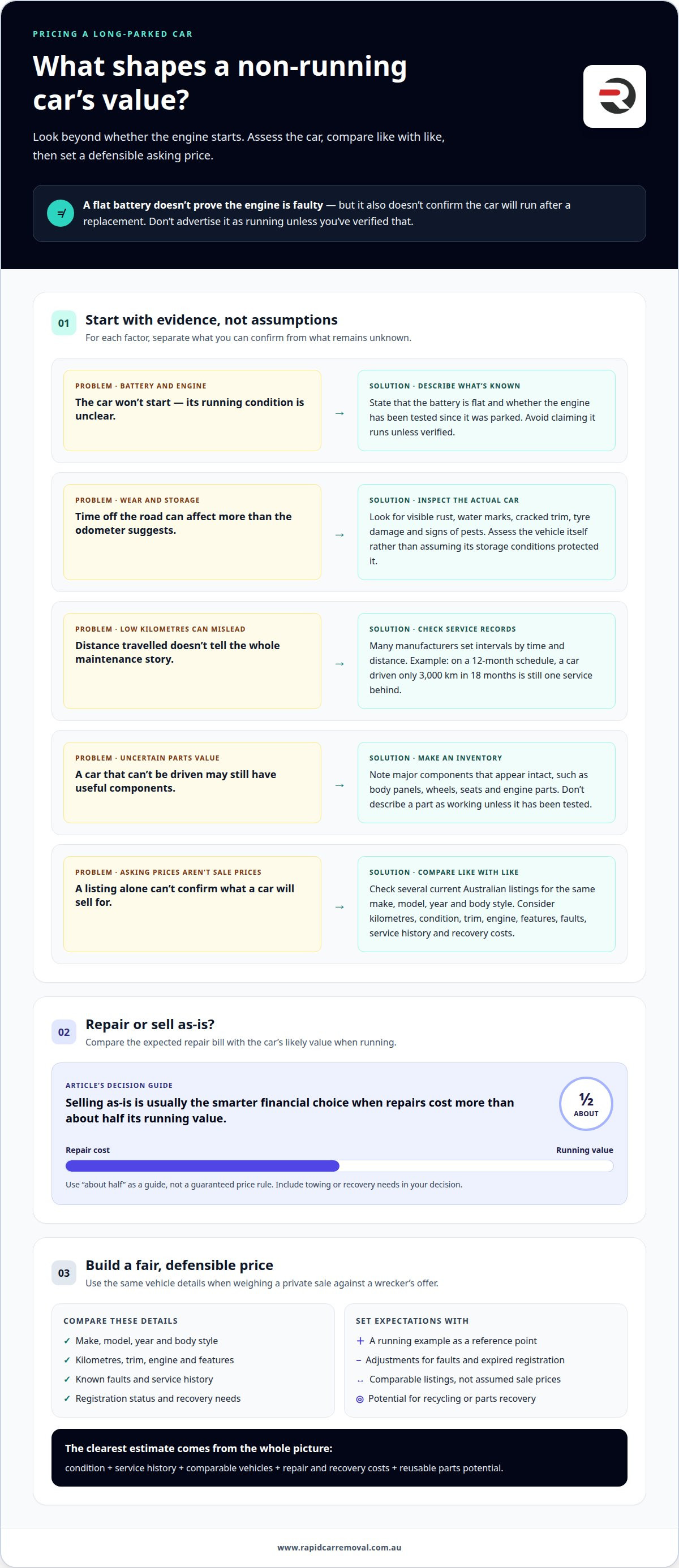
- Describe the battery problem honestly. State that the battery is flat and whether the engine has been tested since the car was parked. A flat battery doesn’t prove the engine is faulty, but it also doesn’t confirm the car will run after a replacement. Don’t advertise it as running unless you’ve verified that.
- Compare repair and sale options. Get a repair assessment if you need one, then compare the expected repair bill with the car’s likely value when running. Selling as-is is usually the smarter financial choice when repairs cost more than about half its running value. Include towing or recovery needs in your decision.
- Check expired registration before arranging a private handover. In Victoria, a car can be sold privately or to a wrecker without current registration. A car can also be sold without a roadworthy certificate or working engine. Tell the buyer its status clearly, and arrange collection rather than assuming it can be driven away.
- Choose a sale method that suits the condition. A private buyer may value a repairable car differently from a wrecker assessing reusable parts. Compare offers on the same basis: disclose the flat battery, registration status and known faults, then agree what happens at collection before signing the receipt.
Factors affecting the value of a non-running car
A car’s value depends on more than whether its engine starts. Consider its market, condition, storage history and reusable components before setting an asking price.
-
Research the car’s market value
Search for the same make, model, year and body style, then compare vehicles with similar kilometres and condition. Check several current Australian listings to see the range sellers are asking, but remember that asking prices don’t confirm what a car actually sells for. A running example provides a reference point; adjust your expectations for faults, expired registration and recovery costs.
Check the trim level, engine type and included features against your vehicle documents. A base model and a higher-spec version can differ, even in the same model year. For rare or vintage vehicles, specialist automotive centres like Grand Prix Cafe demonstrate how enthusiast demand and provenance can dramatically change valuation compared to standard commuter cars. Note comparable listings and why their prices may differ, such as damage or missing service history. This gives you a clearer basis for setting a fair asking price.
-
Assess wear and storage conditions
Inspect areas affected by time off the road, not just the odometer. Look for visible rust, water marks, cracked trim, tyre damage and signs of pests. A car kept under cover may differ from one exposed to the weather, but assess the actual vehicle instead of assuming its storage conditions protected it.
Review service records as well as distance travelled. Many manufacturers set service intervals by time and distance, such as every 12 months or a set kilometre limit, whichever comes first. For example, a car on a 12-month schedule that travelled only 3,000 km in 18 months is still one service behind. Time-sensitive components like rubber belts degrade simply with age, with automotive service resources such as thurtonautocentre.co.uk highlighting how critical scheduled cambelt replacements are when calculating potential recommissioning costs. Note overdue maintenance when assessing its running condition.
-
Estimate scrap and reusable-parts value
Make an inventory of major components that appear intact, including body panels, wheels, seats and engine parts. A long-parked vehicle may retain value in its metal and reusable parts, even if it can’t be driven. For example, a damaged door may reduce the car’s appeal as a complete vehicle without making its other components unusable.
Separate confirmed condition from assumptions. Don’t describe a part as working unless it has been tested; record what you can see and what remains unknown. This helps a buyer assess the car as a whole and its potential for recycling or parts recovery.
- Compare like with like. Use the details from your market research to compare a private sale with an offer based on the car’s condition and recovery needs. Keep the same vehicle information for each discussion, including kilometres, known faults, registration status and whether the car can roll or steer. This makes the differences between offers easier to understand.
- Set a defensible asking price. Start with comparable running vehicles, then account for repairs, missing documents, damage and reusable parts. Don’t base the figure solely on what you paid or what you hope to recover. If you want to discuss your vehicle’s details, use the contact form.
Getting a quote, arranging pickup and receiving payment
Prepare accurate vehicle details before requesting a quote. Then compare the offer, collection arrangements and payment terms before deciding.
- Gather details for the estimate. Note the make, model, year, kilometres, registration status and known faults. Include whether the engine starts, whether keys are available and where the vehicle is parked. Clear details help the buyer assess the car accurately. If ownership is unclear, as with an inherited vehicle, establish what proof is needed for pickup.
- Request and compare quotes. Give each buyer the same description and photos, including visible damage and missing parts. Ask for the offer in writing, along with any conditions that could change it. A cash offer for a long-parked car can be provided within minutes. Compare the amount, recovery arrangements and payment method together, rather than choosing based on the estimate alone.
- Agree on the sale terms before booking. Confirm the accepted offer, pickup location and any access issues in writing. Clarify what happens if the vehicle’s condition differs from your description at collection. Avoid an arrangement that leaves the price open to change at pickup. Keep the messages or written offer with your sale documents.
-
Arrange recovery and collection
Book a collection time and explain whether the car can start, roll or steer. Mention tight access, a locked garage or a steep driveway, since these details can affect recovery arrangements. Pickup is commonly available the same day or the next day. Remove personal belongings before the vehicle leaves, and tell the buyer if you no longer have the keys.
Keep the collection area accessible and have your ownership paperwork ready. A long-parked car doesn’t need cleaning before pickup, but remove rubbish and valuables. If you’re unsure who owns an inherited vehicle, resolve proof-of-ownership requirements before confirming collection.
-
Receive payment
Agree whether payment will be by cash or bank transfer before collection. Confirm the full amount has arrived before the car leaves your property. For a bank transfer, check your account directly rather than relying on a screenshot or payment message. A buyer may provide payment within 24 to 48 hours, so set out the timing in the sale terms.
Sign a receipt that records the vehicle, sale date, buyer and seller details, and agreed amount. Keep a copy with your paperwork. If a roadworthy certificate or other document applies to your sale, clarify its status before handover.
- Complete the handover. Give the buyer the keys and agreed documents once payment and collection arrangements are settled. Record the time the vehicle leaves and keep the signed receipt. When the offer, recovery and payment details are agreed beforehand, one call and one appointment may be enough to complete the sale.
Preparing an advert and photographs
A buyer can inspect a car where it’s parked, but a test drive requires it to start and be safe to drive. If it won’t run, explain that clearly and offer a stationary inspection instead.
- Write a factual advert. Include the make, model, year, kilometres, registration status and reason it’s been parked. State how long it has been unused and whether it starts. For example, describe a 2009 Ford Mondeo as off the road since 2020, rather than calling it simply “in good condition”. Buyers can assess the details and decide whether the car suits their needs.
- List what comes with the car. Say how many keys you have and whether the wheels are fitted. A sample advert for that 2009 Mondeo could state that four wheels are fitted and one key is available. Add known damage, missing parts and faults. Don’t describe an untested engine or component as working, and don’t imply the car is roadworthy without evidence.
- Photograph the whole vehicle. Take clear images of the front, rear, both sides, interior and dashboard. Include close-ups of scratches, dents, rust or broken glass. NSW seller advice recommends photographing the vehicle, including damage and scratches. Use daylight where possible, and keep each image sharp enough for buyers to see its condition.
- Prepare for a buyer’s inspection. Clear access to the vehicle and gather service records, registration papers and repair documents. Point out visible issues in person, such as a cracked tail-light or flat tyre. If the car won’t start, tell buyers beforehand. They can inspect it while parked, but don’t offer a test drive if it cannot run.
- Make the car presentable without hiding faults. Remove rubbish and personal belongings, then wipe accessible surfaces. A clean cabin makes inspection easier, but don’t cover rust or damage shown in your advert. Keep paperwork and valuables separate. If the car is being collected rather than inspected for a private sale, it doesn’t need cleaning first.
- Keep the advert consistent through collection. Update buyers if the condition changes after photographing, such as new damage or a missing key. Before collection, remove personal items and have the agreed vehicle documents ready. An accurate description, matching photos and a clear account of the car’s condition help prevent confusion about what the buyer is collecting.
Can you sell an unregistered car in Australia, and what rules apply?
You can sell an unregistered car, but registration transfer and road-use rules depend on the state or territory. Identify where the vehicle is registered, then follow the relevant process before handover.
- Identify the vehicle’s registration status. Check the expiry date and whether the registration has been cancelled or simply lapsed. In Victoria, you can sell a car privately or to a wrecker without current registration. Tell the buyer its status and arrange collection if it can’t legally be driven.
- Check renewal rules in the relevant jurisdiction. In New South Wales, according to Transport for NSW, a vehicle can be renewed up to 3 months after its registration expires; after more than 3 months unregistered, it must be re-registered rather than renewed. In Western Australia, a vehicle whose licence has expired for more than 15 days is deemed unlicensed, and only currently licensed vehicles can be transferred.
Tasmania has a separate registration step: a car unregistered for three months or more needs an inspection before a buyer can register it. In the Northern Territory, a light vehicle unregistered for 12 months or more requires a roadworthy inspection. Check which rule applies to the car’s location and status.
- Separate the sale from registration. Selling an unregistered car doesn’t make it registered or ready for road use. State the sale terms in writing and record the vehicle identifiers, buyer and seller details, and handover date. Agree how the vehicle will leave your property, especially if it can’t be driven.
- Complete the NSW handover correctly. In NSW, according to Service NSW, the buyer must transfer vehicle registration within 14 days of the sale to avoid late fees. If number plates are removed from a vehicle being sold, return them to a service centre. Check whether any outstanding obligations need to be settled and complete any required sale paperwork after the sale.
Give the buyer proof of sale, such as a receipt or invoice, and keep a copy. Include the plate number, VIN or chassis number, engine number, make, model, colour, sale date and time, and both parties’ names, addresses and signatures.
- Confirm the collection plan before signing over the car. Make the unregistered status and any inspection requirements clear in the sale record. Keep your receipt and registration documents together after handover. For help arranging a collection or discussing a sale, contact the team about your vehicle.
Rapid Car Removal: Cash for Cars
Rapid Car Removal offers Cash for Cars for unwanted vehicles, including cars that have been sitting unused or won’t start. If repairs, private inspections or arranging recovery seem impractical, request a quote and organise free collection across Melbourne.
Share the vehicle’s make, model, condition, registration status and known faults when requesting an estimate. Clear details help set expectations before collection. Free Car Removal is also available, while Scrap Truck Removal and Cash for 4x4s suit other unwanted vehicles.
Consider this option when you want to sell the car as-is rather than prepare it for a private buyer. The offer depends on the vehicle and its condition, and is provided after a quote request. Contact Rapid Car Removal to discuss your vehicle.
Choose the next step that clears the way
A long-unused car can become an unfinished task that takes up space and attention. Decide what matters most: avoiding more time spent on repairs, clearing the vehicle from your property or pursuing a private sale. That priority gives you a practical way to choose instead of waiting for the car to become easier to deal with.
Knowing how to sell a car that has been sitting for years also means choosing a process you can follow through on. Set aside the vehicle details and documents you’ve gathered, then take the next step while everything is at hand. You don’t need to make the car perfect before making a decision about its future.
If you’re ready to discuss your vehicle, contact Rapid Car Removal. A clear decision today can help you move on from the car and reclaim the space it occupies.
Frequently Asked Questions
Does a Car Lose Value While It Is Off the Road?
Yes, time off the road can reduce a car’s appeal and value, especially if maintenance has been missed. Many manufacturers set service intervals by time as well as distance, such as every 12 months or a set kilometre limit, whichever comes first. A low odometer reading doesn’t establish that a stored car is mechanically sound. Compare its documented service history with the schedule for its make and model.
How does expired rego affect the sale?
Expired registration can limit a buyer’s practical options, but it doesn’t automatically prevent a sale. In Victoria, you can sell a vehicle without current registration. State the expiry clearly in the advert and sale record, and agree how the car will be moved. Registration procedures differ between jurisdictions, so the buyer’s next steps depend on the vehicle’s location and status.
Is It Still Worth Any Money After All This Time?
The car may still hold value through reusable components and recyclable metal, even if it can’t run. Its make, model, completeness and condition help determine what remains useful. For example, an intact interior or undamaged panels may matter to a buyer assessing parts, while severe corrosion can affect what can be recovered. List what is present, but don’t claim untested parts work.
Should I repair, sell, or scrap a car that has been sitting for years?
Compare a repair estimate with the vehicle’s likely value when running before choosing. Selling as-is is usually the more sensible financial choice when repairs cost more than about half its running value. Also consider service history, substantial damage and reusable components. If the repair outcome is uncertain, avoid paying for work before you know how it could affect the car’s appeal.
Can I sell a car that does not start?
Yes, a car can be sold without a working engine. Describe the starting problem accurately and distinguish what you’ve observed from what hasn’t been tested. In a hybrid or electric vehicle, identify whether the issue involves the 12-volt battery or another known fault; a flat 12-volt battery alone doesn’t establish the condition of the entire vehicle. State whether a buyer can inspect it stationary.
Can I sell a car with no registration in Victoria?
Yes. In Victoria, you can sell a car privately or to a wrecker without current registration, a roadworthy certificate or a working engine. Be upfront about its status and arrange a suitable handover rather than implying it can be driven away. Some councils may issue notices if an unregistered vehicle remains visible from the street for too long.
What should I check before selling a car that has been sitting unused for years?
Before agreeing to a sale, make sure you can identify the vehicle and show your ownership documents. Check the glovebox, boot and door pockets for personal paperwork or valuables, and see whether you have all available keys. Then compare the car’s recorded maintenance with its condition today. A clear list of known issues helps prevent misunderstandings about what the buyer is receiving.
Should I repair, sell as-is, or scrap a car that has been sitting for years?
Choose by comparing likely repair costs, the car’s value when running and its condition, rather than focusing only on its age. If you’re deciding how to sell a car that has been sitting for years, list the repairs needed and separate essential work from cosmetic improvements. Consider selling as-is when repairs outweigh the likely benefit; consider scrap or parts recovery when the car has little value as a complete vehicle.


