

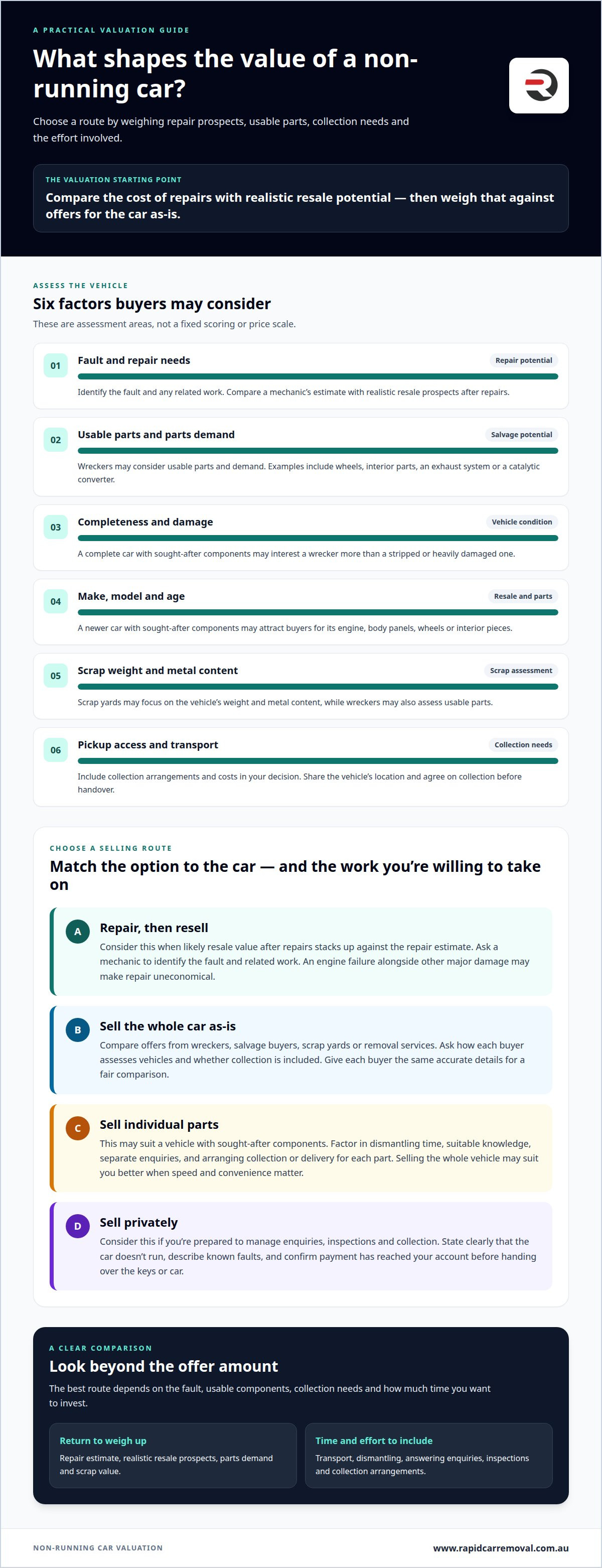
A non-running car can still be worth more than scrap. To work out how to value a non-running car, assess its fault, age, completeness, make and model, usable parts and access for pickup. Compare the likely cost of repairs with its realistic resale value, then weigh that against offers for the car as-is from wreckers, scrap yards or car removal services.
A car that won’t start may still have valuable working parts, and its overall condition affects what a buyer may offer. Your best option depends on whether you’re willing to arrange repairs or sell parts, or would rather sell the whole vehicle as-is.
This guide shows you how to estimate a fair selling price, compare private buyers and removal options, and prepare useful details and photos for quotes. You’ll also learn what to organise before pickup or sale, so you can make a clear decision and avoid surprises along the way.
Key Takeaways
- Set a realistic value by weighing repair costs against the car’s resale potential and its worth as-is.
- Give buyers clear details about the vehicle’s condition and access so they can assess it more accurately.
- Compare sale options by considering the likely return alongside the time, effort and transport each involves.
- Look at parts demand, scrap metal values and collection costs to understand what may influence an offer.
- Gather ownership documents and service records, and plan the handover before the car is collected or sold.
Where can I sell my non-running car?
Choose between repairing the vehicle, selling it as-is, or selling it for salvage or parts. The right route depends on the fault, usable components, collection needs, and how much time you want to invest.
- Compare the repair estimate with the car’s likely resale value after repairs. For example, an engine failure may make a repair uneconomical if other major components are also damaged. Ask a mechanic to identify the fault and any related work, then weigh the estimate against realistic resale prospects. If the figures don’t stack up, selling the car in its current condition may be more practical.
-
Consider scrap and salvage options
Consider whether to sell the damaged car to a wrecker, offer it as salvage, or sell it for scrap. A salvage buyer may want a vehicle that can be repaired or dismantled for parts. Even a car beyond repair can have reusable components, such as wheels, interior parts, an exhaust system, or a catalytic converter. Describe the damage accurately, and don’t present an untested vehicle as road-ready.
-
Understand scrap and wrecker pricing
Ask how the buyer assesses vehicles before comparing offers. Scrap yards may focus on weight and metal content, while wreckers may also consider usable parts and demand for them. A complete car with sought-after components may interest a wrecker more than a stripped or heavily damaged one. Give each buyer the same details to compare offers fairly.
- Decide whether selling individual parts is worth the extra work. A newer car with sought-after components may attract buyers for its engine, body panels, wheels or interior pieces. However, dismantling takes time and requires suitable knowledge. You’ll also need to manage separate enquiries and arrange collection or delivery for each part. Selling the whole vehicle may suit you better when speed and convenience matter more.
- Choose a private sale only if you’re prepared to manage enquiries and collection. State clearly that the car doesn’t run, describe known faults, and include clear photos. Private sales can expose you to fake payment messages, false transfer claims, or pressure to release the vehicle early. Confirm that payment has reached your account before handing over the keys or car.
- Compare the whole process, not just the offer. A private buyer may want to inspect the vehicle, while a salvage buyer or wrecker may focus on repair potential, parts, or metal. Include transport arrangements, dismantling effort, and time spent answering enquiries in your decision. If you sell as-is, describe the fault accurately and agree on collection before the handover.
Information and photos needed for a quote
- Start with the vehicle’s identifying details. Share its registration number, postcode, make, model and year if available. The registration number helps identify the vehicle, while the postcode gives buyers its location and collection context. If the car is unregistered, say so rather than leaving its status unclear. Use the same details for each quote request to make responses easier to compare.
- Describe the fault in plain language. Say whether the engine starts, whether the car moves under its own power, and what happened before it stopped working. For example, explain if it stopped after an overheating warning or has a damaged transmission. Separate what you know from what you haven’t diagnosed. This helps buyers assess the car as it stands, rather than assuming it runs.
- List damage and missing parts that affect the car’s condition. Mention collision damage, broken glass, rust, water exposure, missing wheels, or removed components. Note whether the keys are available and whether the vehicle is complete. Buyers may assess usable parts, repair potential, and scrap value differently. Don’t describe a visible dent as the only damage if you know of other issues.
- Take clear photos in daylight before requesting quotes. Include the front, rear, both sides, interior, dashboard, and engine bay. Photograph close-ups of damaged panels, warning lights, or missing parts. Keep enough of the vehicle in each frame to show where the damage is. If it won’t start, don’t try to create a dashboard photo with the engine running.
- Ask buyers what each quote covers. Clarify whether the amount is for the car as described and whether collection is included. Quotes based on different details or assumptions aren’t a fair comparison. Note each offer, the information provided, and any conditions attached. This record can help you spot changes in the terms before agreeing to sell.
- Request more than one quote using the same description and photos. Compare the amount with collection arrangements, payment method, and any inspection conditions. A higher offer may depend on the vehicle matching the details you supplied. Get the terms in writing before arranging collection, and make sure payment and transfer arrangements are clear before handing over the car.
- Keep proof of ownership ready for the sale and handover. Buyers may need to establish that you can sell the vehicle, even if it’s unregistered or won’t start. Don’t send sensitive documents to an unknown contact before understanding why they’re needed. For help preparing a quote request, use the contact form with the vehicle details and condition information.
Comparing private buyers, scrap yards and removal services
Match the buyer to the vehicle’s condition, likely value, and collection needs. Compare what each option involves, not just the offer.
- Consider a private sale if the car has repair potential or sought-after parts. A private buyer may pay for a vehicle they can repair, but you’ll need to manage enquiries, inspections, and collection. State clearly that it won’t start and describe known faults accurately. If it’s unregistered, include that detail in the listing so buyers understand its status before arranging an inspection.
- Approach a dealer when the vehicle is relatively new and appears repairable. A dealership may assess whether repairs make sense before reselling it, particularly if buyers still seek that make and model. Established dealerships like Tom Whiteside Chrysler Dodge Jeep Ram routinely evaluate used vehicles to determine if trade-in or refurbishment makes commercial sense. This route may not suit a car with extensive damage or a major mechanical failure. Share its condition and repair history so the dealer can assess its resale potential.
- Compare a scrap yard’s offer with the car’s weight and metal content in mind. A yard may focus on recoverable metal rather than resale prospects or individual parts. This can suit a badly damaged car with little repair potential. Ask whether the assessment depends on the car being complete, as missing wheels or removed components can affect its valuation.
- Ask a wrecker to assess usable parts as well as scrap metal. An engine, gearbox, doors, or interior components may have value if they can be reused. A wrecker’s assessment can differ from a yard’s because the make, model, condition, and demand for parts matter. This may suit a damaged car that still has working components, even if it can’t move under its own power.
- Weigh a car removal service against the effort of arranging transport yourself. Rapid Car Removal buys non-running vehicles in Melbourne and includes free towing, removal, and paperwork. Its free same-day pickup can simplify collection when you can’t drive the car. Share the vehicle’s condition and location to request a quote and discuss the collection.
- Compare each option using the same vehicle details and sale conditions. Record the offer, collection arrangements, payment method, and any inspection conditions. Registration status, access, and whether the car is complete may affect the process. A higher offer may require you to arrange transport or manage a private inspection, so consider the time and effort involved before deciding.
What Market Conditions Can Affect Value in 2026-2027?
Towing or collection costs reduce your net return when a buyer factors them into an offer; distance and access affect the transport job. Valuable, reusable parts can lift a vehicle’s appeal when buyers want them, though their condition and demand matter.
- Assess the vehicle’s condition and repair potential first. An engine failure, collision damage, or missing components affects what buyers can recover or resell. A complete car with working parts may attract interest beyond its scrap metal. Record what works, what has failed, and what is damaged so buyers can assess the vehicle accurately.
-
Assess factors affecting value
List the vehicle’s age, make, model, completeness, and known faults. Then consider which components may still be usable, such as the engine, gearbox, wheels, or interior. A popular model with intact parts may interest a wrecker, while extensive damage can shift attention towards scrap metal. A part’s value depends on its condition and buyer demand, not simply on its presence.
- Consider demand for used parts when comparing offers. A component has greater resale potential when buyers need it and it can be recovered in usable condition. For example, an intact engine in a sought-after model may make the vehicle more attractive than a stripped car. Parts value is part of the whole-car assessment: buyers also consider removal work and the condition of the remaining vehicle.
-
Consider market effects on offers
Compare the factors influencing offers during 2026-2027, including used-parts demand, scrap metal values, labour, towing, recycling and freight pressures. These conditions affect what buyers can recover and the work required to process the car. A shift in metal values can change a scrap-based assessment, while parts demand can influence a wrecker’s interest. Use current quotes rather than relying on an older estimate.
- Ask how collection affects each offer. Distance, restricted access, and the vehicle’s position can change the transport arrangements. A car in a tight driveway, for example, may need different handling from one beside an accessible road. Compare the amount offered with any transport costs included, and clarify what the collection terms assume. Rapid Car Removal offers free towing and removal in Melbourne.
- Revisit your estimate if market conditions or the vehicle’s details change. A new diagnosis can reveal that the engine or another major part is unusable, while a discovered fault can reduce repair potential. Likewise, an offer based on strong parts demand can differ from one focused on scrap metal. Keep the description consistent across buyers, then weigh each current offer against its assumptions and collection terms.
Preparing for pickup or sale
Prepare ownership documents, access details, and the handover before agreeing to a sale. Rules for unregistered vehicles differ across Australia, so follow the process that applies in Victoria.
- Gather your registration certificate, proof of ownership, and available service records. These documents help establish the vehicle’s identity, ownership, and history. Buyers may purchase an unregistered vehicle, but you’ll need to establish ownership. If an ownership document is missing, contact the relevant Victorian authority about replacement documents before arranging collection.
- Explain the car’s registration status when agreeing on collection. An unregistered vehicle can generally be sold, but its status may affect the handover process. State whether it’s registered, and don’t imply it can be driven away if it can’t move under its own power. Follow Victoria’s process for transferring or cancelling registration, as applicable to the sale.
- Remove personal belongings and check the cabin, boot and glovebox. Look under seats for paperwork, keys or personal items. You don’t need to detail the interior for a non-running car, but clearing loose belongings makes the handover easier. Keep the keys and documents together, especially if the buyer needs them to identify or move the vehicle.
- Clarify collection arrangements before confirming a sale. Tell the buyer where the vehicle sits, whether access is restricted, and if it can roll or steer. Ask what the quote includes, including any towing or collection costs. Don’t assume free towing forms part of an offer; if you have to arrange your own transport—similar to regional recovery specialists such as Bernabe Towing & Recovery—factor those fees into your bottom line. Agree on the pickup location and payment method before the vehicle leaves your property.
- Complete the ownership transfer and keep a record of the handover. Note the sale date, buyer details, and vehicle information, then retain copies of signed paperwork. Follow the applicable Victorian transfer process and keep a record of any required notification. This documentation shows when you handed over the vehicle and provides a clear record if questions arise later.
- Handle number plates and registration cancellation according to Victoria’s process. The preparation guidance recommends returning plates to the transport authority before selling. Don’t leave plates attached without understanding the steps required for your sale. Keep any receipt or cancellation confirmation with your sale paperwork for your records.
- Check the final terms before handing over the keys. Match the agreed amount and vehicle condition against the paperwork, and confirm payment has cleared through your own account. Don’t rely on a screenshot or message as proof of payment. For help organising a quote and collection details, send your vehicle details.
Rules differ across Australia. In Victoria, follow the applicable process for transferring or cancelling registration, provide proof of ownership, disclose the vehicle’s registration status, and handle the number plates according to Victoria’s process.
Rapid Car Removal
Rapid Car Removal can help when you’re ready to sell a non-running vehicle instead of arranging repairs or dismantling it for parts. Share its make, model, condition, known faults, and pickup location to request a quote. Clear details help assess the car as described and make collection arrangements easier.
If your vehicle can’t be driven, Rapid Car Removal’s Free Car Removal service can save you arranging transport yourself. Consider selling the whole car after weighing repair potential, parts demand, and scrap value against the effort of a private sale. Contact Rapid Car Removal to discuss your vehicle and request a quote.
Choose your next step with confidence
Knowing how to value a non-running car helps you choose a sale option that suits your priorities, whether you want to avoid repairs or move on from a vehicle taking up space. Use your assessment as a starting point, then balance the likely return against the time and effort involved. When the terms and handover arrangements are clear, you can proceed with confidence.
Rapid Car Removal offers Cash for Cars, Free Car Removal, and Scrap Truck Removal. These services can help you sell an unwanted vehicle and arrange collection in Melbourne. Share the details you’ve gathered and request a quote to decide on your next step.
Contact Rapid Car Removal today to discuss your vehicle. Take the next step when you’re ready, with a clearer idea of what matters to your sale.
Frequently Asked Questions
How do I find out the value of my non-running car?
Estimate its value by comparing repair potential, usable parts and scrap value, then request written offers for the vehicle as it stands. To work out how to value a non-running car, gather its make, model, age, fault details and photos before approaching buyers. For example, a car with a failed starter and intact components may be assessed differently from one with extensive collision damage. Compare offers using the same description.
What is a ‘non-runner’ car?
A non-runner is a vehicle that cannot start or move under its own power. A car with a flat battery may qualify if it won’t start, even if the rest appears undamaged. A vehicle that starts but cannot be driven safely because of a mechanical fault may also be treated as non-running by a buyer. Describe what happens when you try to start or move it.
How do I sell a broken or damaged car?
Choose whether to sell it as-is for repair, salvage, parts, or scrap. Before listing it, separate confirmed faults from symptoms: “engine won’t start” is more precise than guessing the engine has failed. Photograph damage from several angles and state whether parts are missing. A private buyer may want to inspect it, while a wrecker may assess reusable components. Agree on payment and collection before handover.
Repair it or sell it as-is?
Repair the car only if its likely resale value justifies the work and effort. Ask a mechanic to identify the fault and any related problems, then compare the repair estimate with realistic sale prospects. For example, replacing one failed component may make sense if the rest of the car is in good condition. If repairs uncover further faults or the vehicle has substantial damage, selling it as-is may be more practical.
What counts as a non-running car?
A car is non-running when it won’t start or can’t move under its own power. That includes a vehicle with a failed starter, engine trouble, or a transmission fault that prevents movement. Don’t assume it’s running just because the dashboard lights come on. Tell buyers exactly what you observe, such as whether the engine turns over, makes a sound, or remains completely unresponsive.
What should you prepare before pickup or sale?
Set aside proof of ownership, available service records, keys and any sale documents. Remove personal items from the cabin and boot, then make sure the vehicle’s location and access are clear for collection. Keep a written record of the buyer, agreed terms and handover. If number plates or registration need attention, follow the process for your state or territory rather than relying on another jurisdiction’s procedure.
What affects the value of a non-running car in Australia?
Value depends on the fault, overall condition, age, completeness, make and model, usable parts, scrap metal content and collection access. Parts demand and recycling or transport costs can also shape offers. For instance, an intact vehicle with sought-after components may interest a wrecker more than a stripped car. A mechanic’s assessment can help identify repair needs, while separate buyer quotes show how those factors affect current offers.
How can I identify the make, model, year and condition of a non-running car?
Start with the registration certificate, service records, or purchase documents, which may identify the make, model, and year. If documents aren’t available, check the vehicle identification number and compliance plate. Then record visible damage, missing parts, and known mechanical symptoms. Don’t guess at a fault based only on a noise or warning light. Clear photos of the vehicle and its identifying details help buyers assess the information.


